Introduction
Your education section provides employers with an overview of your academic background and relevant qualifications. Depending on your career stage, it can be one of the most important parts of your resume or a supporting section that complements your professional experience.
If you are a recent graduate, your degree, academic projects, relevant coursework, and achievements may help demonstrate your preparation for your first professional role. If you have several years of work experience, your education section may only need to provide the qualification, institution, and completion date.
However, not everyone's education history follows the same path. You might still be studying, have completed a degree but not received the final certificate, have attended college without graduating, or hold multiple qualifications from different institutions. Knowing how to present these situations accurately can make your resume easier to understand.
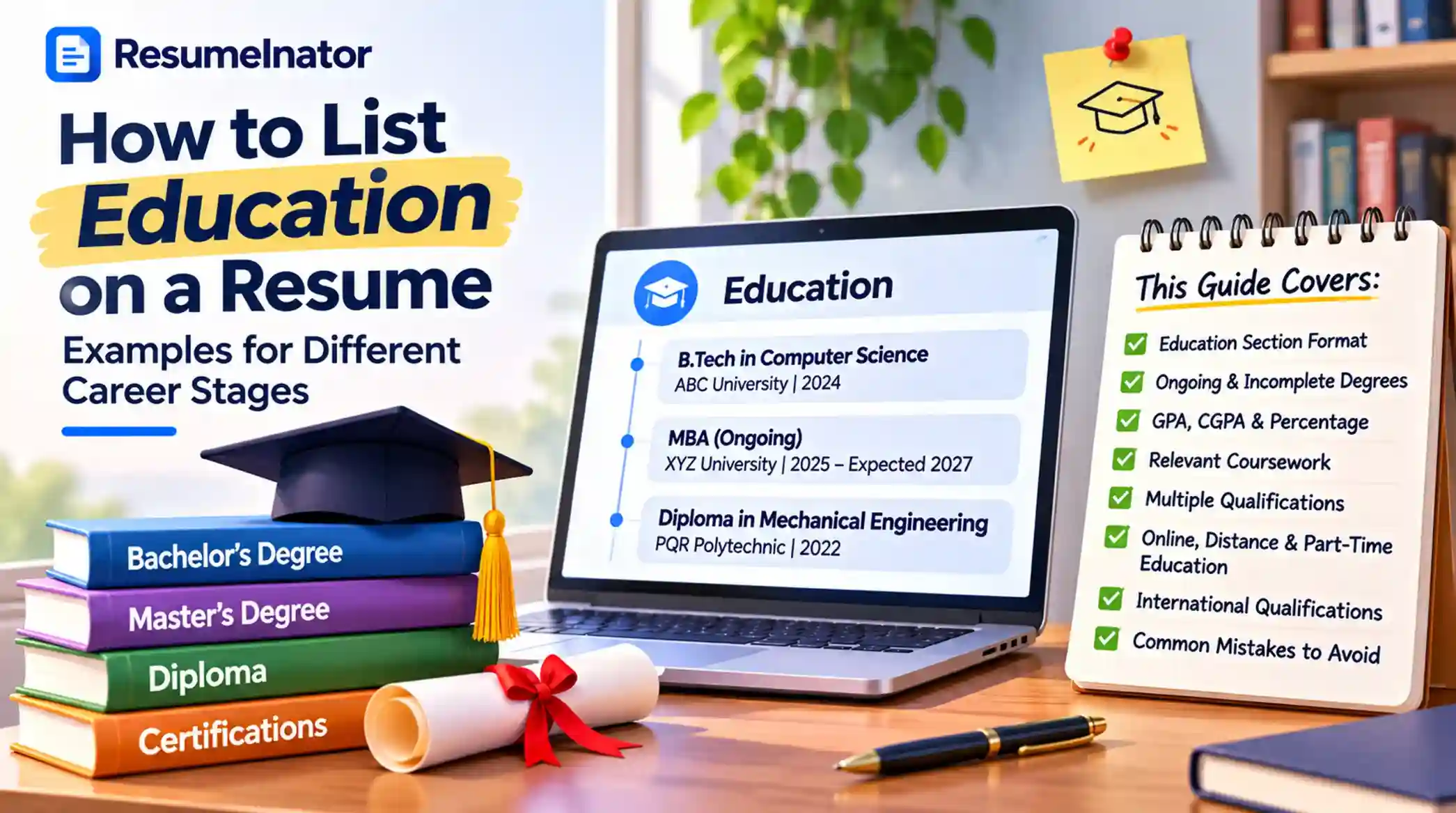
This guide explains how to write an education section, where to place it, which details to include, and how to handle different academic situations. We'll also look at practical examples for freshers, experienced professionals, career changers, and candidates with incomplete or ongoing education.
Key principle: Your education section should communicate your actual qualifications clearly. Include relevant details that support your application, but never imply that you completed a degree, earned a qualification, or achieved an academic result that you did not.
What Should You Include in the Education Section of a Resume?
An education entry should give employers enough information to understand what you studied, where you studied, and whether you completed the qualification. The exact details depend on the qualification and its relevance to the position.
Most education entries include some combination of the following:
1. Degree or qualification name
Write the official name of the degree, diploma, certificate, or qualification you earned or are currently pursuing.
For example:
- Bachelor of Computer Applications (BCA)
- Bachelor of Technology in Computer Science
- Master of Business Administration (MBA)
- Bachelor of Commerce (B.Com)
- Diploma in Mechanical Engineering
Use the correct qualification name rather than relying on informal abbreviations that an employer may not recognize. You can include the abbreviation alongside the full name when appropriate.
2. Institution name
Include the name of the university, college, school, or institution that awarded or provided the qualification.
If your college is affiliated with a university and the distinction is relevant, you may mention both. Make sure the information reflects the institution that actually awarded your qualification.
3. Location
You can include the city and country of the institution when it provides useful context, particularly when applying internationally or listing qualifications from institutions that may not be widely recognized by the employer.
A location is not always necessary. Avoid adding unnecessary address details that take up space without helping the reader understand your qualifications.
4. Graduation or completion date
Include the month and year of completion when useful, or simply the year when that is sufficient for your resume format.
For qualifications you are still pursuing, use an expected completion date rather than presenting the degree as already earned.
5. Academic achievements and additional details
Freshers and recent graduates may benefit from including selected academic achievements when they support the application. These might include:
- GPA, CGPA, percentage, or final academic score.
- Academic honors, distinctions, or awards.
- Relevant coursework or areas of specialization.
- Academic projects or research work.
- Scholarships or significant academic recognition.
These details are optional. Include them when they add useful information rather than filling the section with every subject, examination, or achievement from your academic history.
Where Should Education Go on a Resume?
There is no single mandatory position for the Education section. Its placement should depend on how important your academic qualifications are to the position and how much relevant professional experience you already have.
For freshers and recent graduates
If you have recently graduated and have limited full-time work experience, education can appear near the top of your resume, usually after your professional summary and before Projects or Work Experience.
Your academic background may provide useful evidence of your knowledge, specialization, relevant coursework, and preparation for an entry-level role.
A fresher's resume might follow this order:
Suggested Resume Structure for Freshers
- Contact Information
- Professional Summary
- Education
- Technical Skills
- Projects
- Internships or Experience
- Certifications and Achievements
This is a suggested structure, not a fixed rule. If you have a substantial internship or directly relevant project experience, you can adjust the section order to give that information more prominence.
For experienced professionals
Once you have developed substantial professional experience, employers will often be more interested in your recent responsibilities, skills, and achievements than in the details of your earlier education.
In this situation, place Education after Work Experience. A concise entry containing your qualification, institution, and completion year may be sufficient.
Suggested Resume Structure for Experienced Professionals
- Contact Information
- Professional Summary
- Work Experience
- Skills
- Education
- Certifications, where relevant
For career changers
If your educational background directly supports the new career, you may choose to place Education higher in the resume even when you have previous professional experience.
For example, an experienced professional moving into data analytics after completing a relevant postgraduate qualification may want to make that education easy to find. However, if the qualification is unrelated, your transferable skills, relevant projects, and work experience may deserve greater prominence.
The goal is to organize information according to its relevance rather than following a fixed section order simply because a resume template uses it.
How to Format the Education Section on a Resume
A good education entry should be easy to scan and consistent with the rest of your resume. In most cases, the qualification name should be prominent, followed by the institution and relevant dates.
A simple structure looks like this:
EDUCATION
Degree or Qualification Name
Institution Name | City, Country
Graduation Year
You can adapt this structure by adding a specialization, academic result, or relevant coursework when those details contribute to your application.
Example: Listing a bachelor's degree
EDUCATION
Bachelor of Technology in Computer Science
ABC University | Hyderabad, India
Graduated: 2024
This entry identifies the qualification, institution, location, and graduation year without unnecessary detail.
Example: Listing a degree with academic results
EDUCATION
Bachelor of Commerce (B.Com)
XYZ College | Mumbai, India
Graduated: 2025 | CGPA: 8.2/10
The CGPA is illustrative. Include your actual result only when it is accurate and useful for the application. If you use a percentage, GPA, or CGPA, make sure the scale is clear enough for the reader to understand it.
Example: Listing a degree with a specialization
EDUCATION
Master of Business Administration (MBA)
Specialization: Finance
ABC Business School | Bengaluru, India
Graduated: 2025
A specialization is useful when it helps explain the subject area of your qualification or connects directly to the target role. It does not need to be added when the degree title already provides sufficient information.
List multiple qualifications in a clear order
If you hold more than one academic qualification, place the most recent or highest relevant qualification first. This is generally consistent with the reverse-chronological approach used elsewhere in a resume.
EDUCATION
Master of Business Administration (MBA)
ABC University | 2025
Bachelor of Commerce (B.Com)
XYZ College | 2022
The example uses fictional institutions and dates. Replace them with your actual qualifications and present the details consistently.
Keep the formatting simple. Consistent headings, readable dates, and clearly separated entries help recruiters identify your academic background without searching through long paragraphs.
How to List Ongoing Education on a Resume
If you are currently studying, you can include your qualification even though you have not graduated yet. This is particularly useful for students, freshers, and professionals pursuing additional education while working.
The important thing is to make your current status clear. Include the qualification, institution, start date, and expected completion date when known.
Example: Currently pursuing a bachelor's degree
EDUCATION
Bachelor of Technology in Computer Science
ABC University | Hyderabad, India
August 2023 – Expected June 2027
Currently pursuing
This entry makes it clear that the candidate has not completed the degree yet. The expected graduation date helps employers understand when the qualification may be completed.
Example: Pursuing a master's degree while working
EDUCATION
Master of Business Administration (MBA)
XYZ University | Online
September 2025 – Expected September 2027
Currently enrolled
If you are studying part-time, through distance education, or online, you may mention the study mode when it provides useful context. It is not necessary to explain every detail of your study schedule.
What if you do not know your exact graduation date?
Use a reasonable expected year only when you have a genuine basis for estimating it. If your completion date is uncertain, simply state that the qualification is in progress without inventing a specific graduation date.
Do not present an ongoing degree as completed just because you have finished most of the coursework or are waiting for the final examination.
How to List an Incomplete Degree on a Resume
Not everyone completes every degree or academic program they begin. You may have attended college for a few semesters, discontinued a course, changed institutions, or decided to pursue a different career.
An incomplete qualification can still provide useful information about your academic background, provided you describe it accurately and do not imply that you graduated.
Example: Attended college but did not graduate
EDUCATION
Bachelor of Science in Computer Science
ABC College | Chennai, India
2022 – 2024
Completed coursework through the second year; degree not completed.
This format clearly identifies the program and attendance period without suggesting that the candidate earned the degree.
Example: Discontinued a degree to pursue another qualification
EDUCATION
Bachelor of Commerce (B.Com)
ABC College | 2021 – 2022
Completed one year of study.
Bachelor of Computer Applications (BCA)
XYZ University | 2023 – 2026
Graduated.
If you subsequently completed another qualification, prioritize that completed degree. Include the earlier course only when it provides relevant context or demonstrates useful academic preparation.
Should you explain why you discontinued a degree?
You generally do not need to provide a detailed personal explanation in the Education section. The qualification and attendance period can be enough.
If an incomplete degree is particularly relevant to the position or an application asks about your academic history, provide a truthful explanation when appropriate. Avoid wording that could make the reader believe you completed the qualification.
You should also follow any specific instructions in the employer's application form. Some employers request complete academic records, so omitting an institution from your resume does not remove the need to disclose it when explicitly requested.
How to Write the Education Section If You Do Not Have a Degree
You do not need a university degree to create a useful resume. The education section should reflect the qualifications you actually hold, rather than suggesting that a degree is required for every professional opportunity.
Depending on your background and target position, you may include:
- High school or secondary education.
- Diplomas and vocational qualifications.
- Professional training programs.
- Relevant trade or technical qualifications.
- Industry-recognized educational credentials.
Example: Listing high school education
EDUCATION
Higher Secondary Certificate (Class XII)
ABC Senior Secondary School | Hyderabad, India
Completed: 2024
Secondary School Certificate (Class X)
XYZ School | Hyderabad, India
Completed: 2022
This is an illustrative Indian education example. Use the qualification names, board, institution, and completion dates that accurately reflect your own academic records.
Example: Listing a diploma qualification
EDUCATION
Diploma in Mechanical Engineering
ABC Polytechnic College | Pune, India
Graduated: 2025
A relevant diploma can be an important qualification in its own right. Present its official name clearly instead of describing it as a bachelor's degree or using a different qualification title.
Should you include high school after completing college?
Usually, your highest relevant qualification is sufficient once you have completed higher education. You do not generally need to include Class X and Class XII details when a completed degree already communicates your educational background adequately.
However, high school details may still be relevant when an employer explicitly requests them, when you have no higher qualification, or when a particular academic achievement provides useful context.
Should You Include GPA, CGPA, or Percentage on a Resume?
Your academic score can provide additional information about your education, particularly when you are a recent graduate or applying for an opportunity that specifically considers academic performance. However, including GPA, CGPA, or percentage is not mandatory for every candidate.
When it makes sense to include your score
- You are a fresher with limited professional experience.
- The employer specifically requests an academic score or minimum percentage.
- You have a strong result that supports your application.
- You are applying for an academic program, internship, or graduate opportunity where academic performance is relevant.
Example: Listing CGPA
EDUCATION
Bachelor of Technology in Information Technology
ABC University | Hyderabad, India
Graduated: 2025 | CGPA: 8.4/10
Example: Listing a percentage
EDUCATION
Bachelor of Commerce (B.Com)
XYZ University | Mumbai, India
Graduated: 2024 | Percentage: 78%
These scores are illustrative. Replace them with your actual academic results and use the grading scale followed by your institution.
What if your GPA or percentage is not particularly strong?
If the employer does not request an academic score and it does not add meaningful value to your application, you may leave it out.
You should still provide accurate information whenever an application specifically asks for your grades or academic results. Never alter a score, invent a conversion, or present an approximate percentage as an official result.
Should experienced professionals include academic scores?
Once you have substantial professional experience, your work achievements and relevant skills usually deserve more space. Academic scores often become less important unless the employer specifically requests them or the qualification is central to the position.
When Should You Include Relevant Coursework on a Resume?
Relevant coursework refers to selected academic subjects or modules that support the knowledge required for a particular position. It can be useful when you are a student, recent graduate, or changing careers into an area where your formal education supports the transition.
Example: Coursework for a computer science student
EDUCATION
Bachelor of Technology in Computer Science
ABC University | Expected: 2027
Relevant Coursework:
- Data Structures and Algorithms
- Database Management Systems
- Operating Systems
- Computer Networks
This gives a clearer idea of the subjects the candidate has studied without listing every semester examination or academic module.
Example: Coursework for a data analytics career transition
EDUCATION AND PROFESSIONAL DEVELOPMENT
Relevant Data Analytics Training
Example Training Provider | Completed: 2026
Topics Covered:
- SQL fundamentals
- Spreadsheet-based data analysis
- Data visualization
- Statistical concepts
This example belongs under professional development or training rather than an academic degree section unless the training was part of a formal academic qualification.
How much coursework should you list?
Choose a few subjects that directly support the role. Listing every subject can make the education section unnecessarily long and may distract from more useful qualifications.
Coursework is most valuable when the subject is relevant and the candidate has not yet gained substantial professional experience demonstrating the same knowledge.
How to Include Academic Achievements and Honors on a Resume
Academic achievements can help communicate your accomplishments beyond simply completing a qualification. They may be especially useful for students and recent graduates whose professional experience is still developing.
Depending on their relevance, you may include:
- Academic honors and distinctions.
- Scholarships and merit-based awards.
- University-level competition achievements.
- Research presentations or publications.
- Relevant academic project recognition.
- Departmental or institutional awards.
Example: Listing academic honors
EDUCATION
Bachelor of Science in Mathematics
ABC University | 2025
- Graduated with distinction.
- Received an academic merit award in the final year.
Use the official award or distinction name where possible. If an achievement is based on a particular ranking, competition, or selection process, describe it accurately rather than using broad claims such as "top student" without supporting information.
Should academic projects appear under Education?
You can briefly mention an important academic project under the relevant degree when it directly supports your application. However, if the project deserves more explanation, a separate Projects section may make it easier to present the tools, responsibilities, and outcomes.
Avoid describing the same academic project in full under both Education and Projects. Choose the section that makes the information easiest to understand.
How to List Multiple Degrees on a Resume
If you have completed multiple degrees or academic qualifications, include the ones that contribute to your professional profile. You generally do not need to give every qualification the same amount of space.
A useful approach is to list your most recent or highest relevant qualification first, followed by earlier degrees in reverse chronological order.
Example: Listing a bachelor's and master's degree
EDUCATION
Master of Business Administration (MBA)
ABC University | Bengaluru, India
Graduated: 2025
Bachelor of Commerce (B.Com)
XYZ College | Hyderabad, India
Graduated: 2022
This arrangement makes the candidate's most recent qualification visible first while preserving the earlier academic history.
Example: Listing qualifications from different fields
You may have completed degrees in different subjects, particularly if your career has changed direction. Include both qualifications when they provide useful context or support the position you are targeting.
EDUCATION
Master of Science in Data Science
ABC University | 2026
Bachelor of Commerce (B.Com)
XYZ University | 2023
For someone transitioning from commerce into data science, this combination can communicate both the earlier academic background and the newer qualification relevant to the target profession.
What if you completed multiple diplomas or certificates?
If you have several professional or academic qualifications in addition to your degrees, consider whether they belong in the Education section or a separate Certifications and Training section.
Formal academic degrees can remain under Education, while professional certifications and shorter training programs can be grouped separately. This helps readers distinguish academic qualifications from additional professional learning.
How to List Education From Multiple Colleges or Universities
Your academic history may involve more than one institution. For example, you may have transferred colleges, completed a qualification through an affiliated institution, or changed universities before graduating.
The important thing is to identify the qualification you earned and the institution responsible for awarding it.
Example: Transferring from one college to another
Suppose you began studying at one college and later transferred to another institution, where you completed your degree. You can list the completed qualification under the institution that awarded it.
EDUCATION
Bachelor of Science in Computer Science
ABC University | Graduated: 2026
You generally do not need to describe every administrative detail of a transfer in the resume. However, if previous study at another institution provides relevant academic information, you can include it separately.
Example: Studying at an affiliated college
In some education systems, students attend a college that is affiliated with a university, while the university awards the degree. When this distinction is relevant, you can mention both institutions.
EDUCATION
Bachelor of Technology in Computer Science
ABC Engineering College, affiliated with XYZ University
Hyderabad, India | Graduated: 2025
The example is illustrative. Use the actual affiliation and awarding institution shown in your academic records. Do not describe a college as the degree-awarding university unless it actually has that authority.
How to List Online, Distance, and Part-Time Education on a Resume
Education can be completed through different study arrangements. You may have attended classes on campus, studied online, completed a distance-learning program, or pursued a qualification part-time while working.
The format of study does not automatically determine the value of a qualification. What matters is the actual credential, the institution that provided or awarded it, its recognition where relevant, and how it relates to the position.
Example: Online degree
EDUCATION
Master of Business Administration (MBA)
ABC University | Online Program
Graduated: 2026
Mention the online study mode when it helps explain the nature of the program or when the employer requests it. If the mode does not add useful context, the qualification and institution may be sufficient.
Example: Distance education
EDUCATION
Bachelor of Arts (B.A.) in English
XYZ University | Distance Education
Graduated: 2025
Use the actual study mode and qualification details. If the program has specific recognition or approval requirements in the country where you are applying, verify those details with the appropriate authority.
Example: Part-time education while employed
EDUCATION
Master of Science in Information Technology
ABC University | Part-time
2024 – Expected 2027
Currently pursuing
This format can help explain how you are pursuing a qualification alongside your professional responsibilities. Include the study mode when it provides useful context rather than assuming every part-time program requires a special explanation.
Should you mention the platform used for online learning?
If you completed a short online course, list the course and its issuing provider under Certifications or Professional Development rather than treating it as a university degree.
For example, completing a course through an online learning platform should not be presented as a degree awarded by that platform unless the qualification genuinely represents such a degree.
Keep the distinction between academic qualifications, professional certifications, and course-completion certificates clear throughout your resume.
How to List International Education on a Resume
If you studied in another country or hold an international qualification, make sure the employer can understand the qualification and identify the institution.
Education systems use different degree names, grading scales, qualification levels, and academic structures. A qualification that is familiar in one country may not be immediately recognizable to an employer elsewhere.
Use the official qualification name
Start with the qualification name shown on your official academic documents. Include the institution and country so the reader has enough context to understand where you studied.
EDUCATION
Master of Science in Computer Science
Example International University | London, United Kingdom
Graduated: 2025
This is a fictional example. Use the actual institution name, qualification title, location, and graduation date from your records.
Explain unfamiliar qualifications when necessary
If the qualification name is not widely recognized in the country where you are applying, you may add a short explanation or an accurate equivalent description when appropriate.
Do not automatically convert a qualification into a different degree title simply because the names sound similar. If you have received a formal credential evaluation, follow the wording provided in that assessment when using an equivalency description.
Be careful when converting academic grades
GPA, percentage, and other academic grading systems vary between institutions and countries. A direct conversion may not accurately represent the original result.
If your qualification uses a particular grading scale, state the original result and scale clearly. Provide an equivalent GPA or grade only when it has been calculated using a reliable, applicable method or supplied through an official assessment.
Check whether translated documents are required
If your academic documents are issued in a language different from the employer's working language, you may need an accepted translation during the application or verification process. Follow the employer's instructions and the relevant institutional requirements.
The resume itself should use clear and understandable qualification names, while supporting documents should accurately reflect the original academic records.
Where Should Additional Education and Professional Training Go?
Not every learning activity belongs in the main Education section. Depending on the type of qualification, you may find it clearer to create separate sections for certifications, courses, professional development, or training.
Keep academic degrees under Education
University degrees, diplomas, and other formal academic qualifications generally belong in the Education section. Arrange them so the most recent or relevant qualifications are easy to find.
Use a separate Certifications section for professional credentials
Professional certifications and industry credentials are often easier to identify when grouped under a dedicated heading. Include the issuing organization, award date, and status information when useful.
Use Professional Development for shorter learning activities
If you have completed relevant workshops, short courses, or structured training that does not represent an academic degree or professional certification, a Professional Development or Training section may be more appropriate.
PROFESSIONAL DEVELOPMENT
- Advanced Excel Training | Example Training Provider | 2026
- Introduction to Data Visualization | Example Learning Platform | 2025
- Business Communication Workshop | Example Training Organization | 2025
These entries are illustrative. Include only learning activities you have genuinely completed and that contribute to your professional profile.
You do not need to create separate sections for Education, Certifications, Courses, Workshops, and Training if each contains only one small entry. Group related information when that makes the resume easier to read.
Common Education Section Mistakes to Avoid
The Education section should be straightforward, but small inaccuracies or unnecessary details can make it confusing. Review these common mistakes before submitting your resume.
Presenting an incomplete degree as completed
Do not write a graduation year or completed degree title in a way that suggests you graduated when you did not. Use clear descriptions such as Currently pursuing, Attended, or Completed coursework through the relevant period.
Using an incorrect qualification name
Informal abbreviations and inaccurate degree titles can confuse employers. Use the official name shown in your academic records. You can include a familiar abbreviation alongside it when useful.
Listing unnecessary school details
If you have completed higher education and have relevant professional experience, listing every school and examination may take up space without adding meaningful information. Prioritize your highest relevant qualifications.
Including grades without context
A CGPA, percentage, or GPA should be presented with its appropriate grading scale. Avoid unexplained or inaccurate conversions, and include academic scores when they support the application or are requested.
Adding too much coursework
Listing every subject from your academic history can make the Education section unnecessarily long. Select only coursework that supports the position you are applying for.
Repeating academic projects in multiple sections
If you have already described an academic project in detail under Projects, there is usually no need to repeat the same information under Education. Keep each section focused on its purpose.
Leaving dates inconsistent
Use a consistent date format for completed and ongoing qualifications. Check that expected graduation dates, completion years, and other academic details are accurate.
Adding irrelevant educational details
Your resume does not need to include every workshop, examination, subject, or short course you have ever attended. Choose information that helps the employer understand your qualifications for the target role.
Ultimately, the Education section should provide useful context without competing with more relevant experience or making the resume harder to scan.
Education Section Checklist Before Applying
Use this checklist to make sure your educational information is accurate, relevant, and clearly presented.
- My qualification names match my academic records.
- The institution and awarding university are identified correctly.
- My graduation, attendance, or expected completion dates are accurate.
- Ongoing and incomplete qualifications are clearly labeled.
- My academic scores use the correct grading scale.
- I have included only relevant coursework and achievements.
- Academic degrees are distinguished from professional training and course-completion certificates.
- My international qualifications are described accurately.
- I have removed unnecessary school details and repeated information.
- My Education section is placed appropriately for my career stage.
A clear Education section does not need to be lengthy. It simply needs to communicate what you studied, where you studied, what you completed, and which details are relevant to the opportunity.
Frequently Asked Questions About Education on a Resume
How should education be listed on a resume?
List your degree or qualification, the institution, and your graduation or expected completion date. Include relevant details such as specialization, academic results, or coursework when they support your application. Keep the formatting consistent and place the section according to your career stage.
Should education go at the top or bottom of a resume?
Freshers and recent graduates generally benefit from placing Education near the top because their academic qualifications may provide important evidence of their preparation. Experienced professionals often place it after Work Experience, especially when their professional achievements are more relevant to the role.
Should I include high school on my resume?
If you have completed a relevant college degree, you usually do not need to include high school details unless the employer requests them. High school education can be included when it is your highest completed qualification or when the information provides useful context.
How do I list a degree that I am still pursuing?
Include the qualification, institution, study dates, and expected graduation date when known. Clearly indicate that the degree is currently in progress or that you are pursuing it. Do not present it as completed before you have officially earned the qualification.
Can I include an incomplete degree on my resume?
Yes. When the education is relevant, you can list the program, institution, and period of attendance. Make it clear that the degree was not completed, and include completed coursework or relevant academic details when useful. Never imply that you graduated if you did not.
Should I include GPA or CGPA on my resume?
Including your academic score is optional in many situations. It can be useful for freshers, internships, graduate opportunities, or applications that specifically request academic results. Use your actual score and grading scale, and avoid inaccurate conversions between percentages and GPA systems.
Should I include relevant coursework on my resume?
Relevant coursework can be useful when you are a student or recent graduate and have limited professional experience. Select subjects that support the target position rather than listing every course you have studied. Experienced professionals generally need less academic coursework detail unless it is particularly relevant.
How do I list multiple degrees on a resume?
List your most recent or highest relevant qualification first, followed by earlier qualifications in reverse chronological order. Include the degree name, institution, and completion date for each. You can omit older or unrelated qualifications when they do not add meaningful value to the application.
Should I mention online or distance education on my resume?
You can include online or distance education just like other academic qualifications, using the correct qualification name and awarding institution. Mention the study mode when it provides useful context or when the employer requests it. Describe the qualification accurately and check any relevant recognition requirements.
How do I list international qualifications on a resume?
Use the official qualification name, institution, country, and completion date. If the qualification is unfamiliar to employers in the country where you are applying, a brief explanation or formal credential evaluation may help clarify its level. Avoid converting it into a different degree title without a reliable basis.
Should I include academic achievements on my resume?
Yes, when they are relevant and provide useful evidence of your abilities. Academic honors, scholarships, research, competitions, and significant project recognition can be particularly useful for students and recent graduates. Choose meaningful achievements instead of listing every academic activity.
Can I include professional courses under the Education section?
You can include relevant professional learning, but a separate Certifications or Professional Development section may be clearer when you have several courses or credentials. Academic degrees, professional certifications, and course-completion certificates should be described accurately and distinguished from one another.
Should I include education dates if I have many years of experience?
You can include the graduation year and other relevant details, but you generally do not need to provide a lengthy academic history. Focus on the qualifications that matter to the role and give more space to recent professional experience and achievements.
Conclusion
A well-organized Education section helps employers understand your academic background without making them search through unnecessary details. Whether you are a student, recent graduate, experienced professional, or career changer, the information should reflect your actual qualifications and support the opportunity you are pursuing.
Start with your degree or qualification, institution, and completion date. Add academic scores, relevant coursework, honors, or projects when they provide useful evidence. If you are still studying or have not completed a qualification, make its status clear instead of suggesting that you graduated.
Remember that the importance of education changes throughout your career. Freshers may use academic qualifications to demonstrate their preparation, while experienced professionals can give greater attention to their employment history, achievements, and practical skills.
Ultimately, your Education section does not need to tell your entire academic story. It needs to communicate the qualifications that help an employer understand your background and assess your suitability for the role.
When your information is ready, use ResumeInator's free resume builder to organize your education, skills, experience, and other qualifications into a professional resume.