Introduction
One of the hardest parts of writing a resume is describing your experience in a way that is both concise and meaningful. You may know exactly what you worked on, but turning that experience into a few lines that quickly communicate your contribution can be surprisingly difficult.
This is where resume bullet points matter.
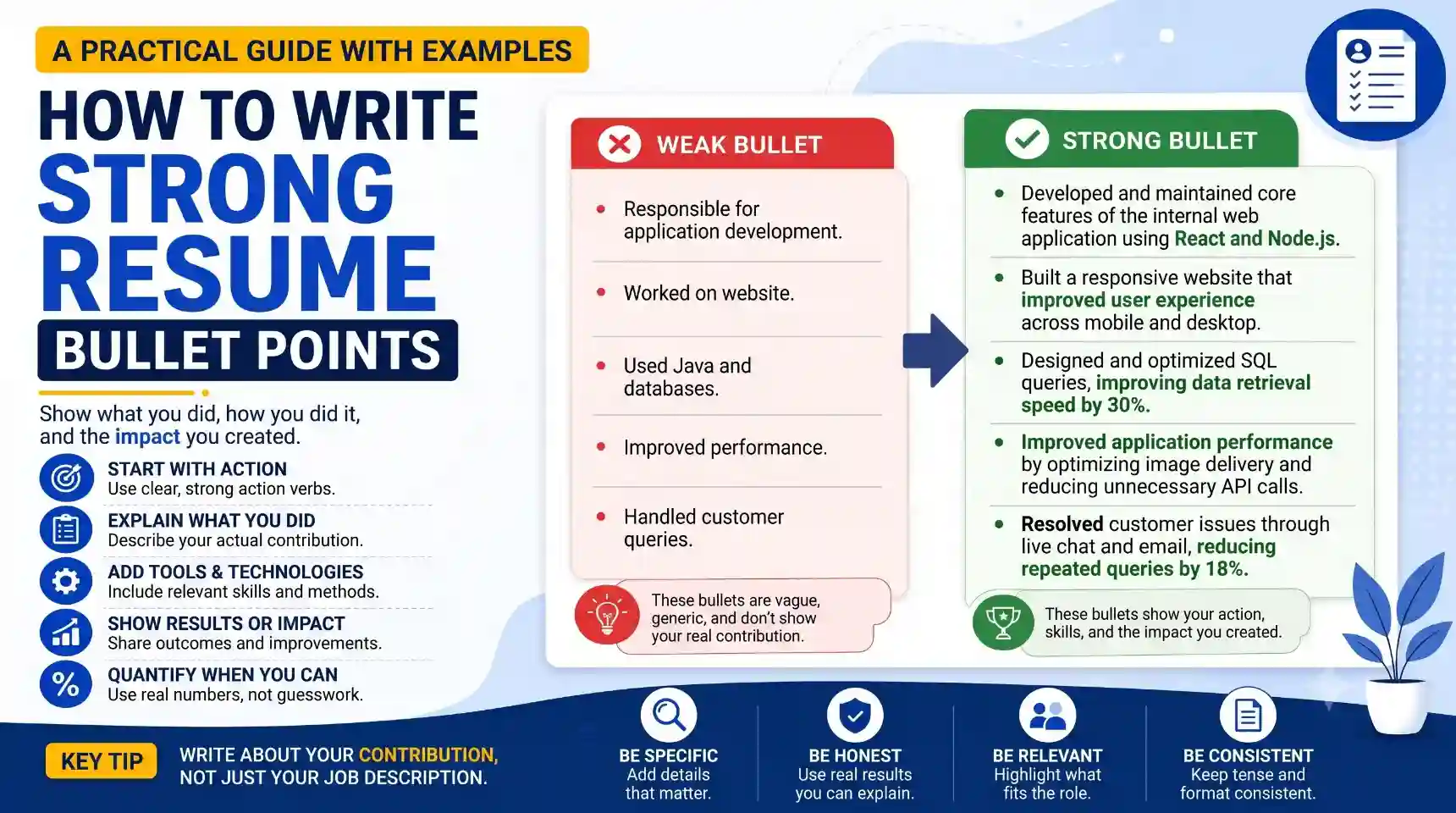
Strong bullet points help recruiters understand what you did, what skills you used, what problems you worked on, and what changed because of your contribution. Weak bullet points often do the opposite: they simply repeat responsibilities, use vague language, or describe activities without giving the reader useful context.
For example, compare:
Worked on website development.
with:
Developed responsive React components for a customer-facing web application and integrated REST APIs for product data.
The second version gives the reader much more information without becoming excessively long.
In this guide, you'll learn how to write effective resume bullet points from scratch, turn responsibilities into stronger accomplishment-focused statements, use action verbs naturally, add metrics when they genuinely exist, and describe experience even when you don't have measurable results.
You'll also see examples for freshers, internships, projects, software development, business, marketing, finance, engineering, and other common career paths.
Important: A strong resume bullet doesn't need an impressive number or a complicated action verb. It needs to communicate your actual contribution clearly.
What Is a Resume Bullet Point?
A resume bullet point is a short statement used to describe your work, achievements, projects, responsibilities, or contributions.
Bullet points are especially useful in Experience and Projects sections because they break information into small, scannable pieces rather than forcing the recruiter to read a large paragraph.
A useful bullet should answer at least one important question:
- What did you do?
- What did you work with?
- What problem did you solve?
- What was your contribution?
- What changed as a result?
Not every bullet needs to answer all five questions. The amount of detail should depend on the type of experience and what is most relevant to the position.
For example:
Developed a responsive React dashboard for tracking customer orders and delivery status.
This single bullet tells the reader the action, technology, type of application, and purpose of the work.
Why Strong Resume Bullet Points Matter
Recruiters often scan resumes rather than reading every line with equal attention. Strong bullets help the most relevant information stand out.
Good bullets can make it easier to identify:
- Your actual responsibilities.
- The skills and technologies you've used.
- Problems you've worked on.
- Achievements and measurable results.
- The level of ownership you've had.
Compare:
Responsible for application development.
with:
Developed backend services using Java and Spring Boot, implemented REST APIs, and integrated PostgreSQL for application data storage.
The second bullet gives the recruiter concrete information about the candidate's actual work.
Strong bullets also make the rest of the resume easier to evaluate because they provide evidence behind the skills and claims listed elsewhere in the document.
ResumeInator Tip: Your Skills section tells the recruiter what you know. Your bullet points should help demonstrate where and how you've used it.
A Simple Resume Bullet Formula
A useful starting framework for writing a resume bullet is:
ACTION
+
WHAT YOU DID
+
HOW / WITH WHAT
+
WHY IT MATTERED
+
RESULT, WHEN AVAILABLE
For example:
Developed
+
responsive React components
+
using JavaScript and TypeScript
+
for customer-facing web applications
+
improving the consistency of the user interface.
Combined into a natural sentence:
Developed responsive React components using JavaScript and TypeScript for customer-facing web applications, improving consistency across the user interface.
This is a framework, not a rule that every bullet must follow exactly. Some bullets may be stronger when they focus on a contribution without a measurable result. Others may need only an action and result.
The purpose of the framework is to help you move beyond vague statements and include useful context.
Step 1: Start With a Clear Action
Starting a bullet with a clear action helps the reader immediately understand what you contributed.
Compare:
Responsible for improving application performance.
with:
Improved application performance by optimizing image loading and unnecessary component rendering.
Common action verbs include:
- Developed
- Designed
- Implemented
- Built
- Created
- Improved
- Optimized
- Automated
- Analyzed
- Resolved
- Coordinated
- Led
- Delivered
- Streamlined
- Configured
Choose a verb that accurately describes what you did. Don't use "led" if you assisted someone else, and don't use "architected" when you only implemented an existing design.
Important: Strong action verbs should make your responsibility clearer, not make your contribution sound larger than it actually was.
Step 2: Explain What You Actually Did
An action verb alone isn't enough. The reader needs to know what you actually accomplished or worked on.
For example:
Developed features.
This tells the reader very little.
A more useful version might be:
Developed checkout and order-tracking features for a React-based e-commerce application.
Now the reader knows:
- What was developed.
- Where it was used.
- The type of application involved.
You don't need to explain every implementation detail. Include enough information for someone unfamiliar with your project or company to understand your contribution.
Step 3: Add the Relevant Tool, Method, or Technology
When a tool, framework, programming language, methodology, or other technology is important to the work, mentioning it can provide useful context.
For example:
Developed REST APIs using Spring Boot and PostgreSQL for an internal inventory management application.
This is more informative than:
Developed backend services for an internal application.
However, don't add technologies simply because they appear frequently in job descriptions. Every technology in your resume should represent something you've genuinely used or meaningfully practiced.
If several technologies were involved, include only the ones that help explain the work or are particularly relevant to the target role.
A bullet isn't a place to reproduce your entire tech stack.
Step 4: Show the Result or Impact
A bullet becomes more powerful when it explains what happened because of your work.
Consider:
Updated the company's reporting process.
This tells us what happened, but not why it mattered.
A stronger version might say:
Automated the monthly reporting workflow and reduced manual preparation time for the operations team.
If a reliable metric exists, you can make the result more specific:
Automated the monthly reporting workflow and reduced manual preparation time by 12 hours per month.
The number above is only an example. Use a metric only when it reflects a genuine result that you can reasonably support.
Results don't always need to be financial. They can include:
- Time saved
- Performance improvements
- Reduced errors
- Improved reliability
- Increased adoption
- Faster processing
- Improved customer experience
- Successful delivery of a project or feature
Step 5: Quantify the Achievement When You Can
Numbers can make an achievement easier to understand because they give the reader context about scale or impact.
Useful metrics might include:
- Percentage improvement
- Revenue or cost impact
- Time saved
- Number of users
- Number of customers supported
- Volume of transactions or requests
- Project size
- Team size
- Processing time
- Reduction in defects or errors
Compare:
Improved website performance.
with:
Reduced average page-load time by 31% through image optimization, code splitting, and lazy loading.
The second example is more specific because it describes both the result and some of the work behind it.
Don't Invent Numbers
A fabricated metric is worse than an honest bullet without a number.
Don't estimate a percentage simply because it sounds impressive. If you don't have a reliable number, use a qualitative result or describe the scope of your contribution.
Improved website performance by optimizing image delivery, code splitting, and unnecessary component rendering.
This is still a useful achievement even without a percentage.
ResumeInator Tip: Numbers should add evidence, not decoration. Use them when they tell the reader something meaningful and truthful.
How to Turn Responsibilities Into Achievements
One of the most common resume-writing problems is describing a job entirely through responsibilities.
Responsibilities explain what you were expected to do. Stronger resume bullets explain what you actually contributed while performing that work.
For example:
Responsible for maintaining the company website.
This isn't necessarily wrong, but it doesn't tell the reader much about the candidate's contribution.
You could make it more specific:
Maintained and updated the company website using HTML, CSS, and JavaScript while resolving frontend issues reported by users.
If you have a genuine measurable outcome, you can go one step further:
Maintained and optimized the company website using HTML, CSS, and JavaScript, reducing recurring frontend issues reported by users.
The last version is stronger only when the result is accurate. You should never add a performance improvement simply because the bullet looks better with one.
A Simple Transformation Method
When you find a responsibility in your old resume, ask:
- What did I actually do?
- What tools, technologies, or methods did I use?
- What problem was I working on?
- What did my contribution change?
- Is there a genuine result or scope I can mention?
You don't need to answer every question in every bullet. The questions are there to help you find information that is missing from a vague statement.
Example: Customer Support
Responsibility:
Handled customer queries.

Stronger:
Resolved customer questions through email and live chat, documenting recurring issues for the support team.

Achievement-focused:
Resolved customer questions through email and live chat while documenting recurring issues that helped the team reduce repeat support requests.
Example: Software Development
Responsibility:
Worked on backend development.

Stronger:
Developed REST APIs using Java and Spring Boot for internal business applications.

Achievement-focused:
Developed REST APIs using Java and Spring Boot and optimized database queries for faster request processing.
Example: Marketing
Responsibility:
Managed social media.

Stronger:
Created and scheduled social media content across Instagram and LinkedIn.

Achievement-focused:
Created and scheduled social media campaigns that increased monthly engagement across Instagram and LinkedIn.
The key difference is that the stronger versions give the reader more information about the candidate's actual work.
ResumeInator Tip: Don't ask, "What was my job?" Ask, "What did I actually accomplish while doing that job?"
How to Write Strong Resume Bullets Without Metrics
Not every job, project, or academic experience comes with measurable results. That's completely normal.
You should not invent percentages, revenue figures, user counts, or other numbers just because resume advice often emphasizes quantification.
When a reliable metric doesn't exist, you can make a bullet stronger by showing one or more of the following:
- The scope of your work
- The technology or method you used
- The problem you solved
- The feature or process you delivered
- The people or teams you worked with
- The purpose of the work
Example 1: Project Work
Built a React-based expense tracker that allowed users to record, categorize, and review personal expenses.
This is a useful bullet even though there is no percentage improvement.
Example 2: Testing
Created automated Jest tests for reusable React components and integrated test cases into the project's development workflow.
Again, the bullet explains the contribution and the context without pretending there was a measurable business result.
Example 3: Academic Work
Analyzed customer purchase data using Python and Pandas to identify purchasing patterns and present findings through data visualizations.
For academic or personal projects, describing the problem, method, and outcome of the work is often more useful than forcing a number into the sentence.
Remember: A specific bullet without a number is better than a fabricated achievement with one.
Resume Bullet Points for Freshers
Freshers often assume they don't have enough experience to write strong resume bullets. In reality, academic projects, personal projects, internships, coursework, volunteer work, student organizations, and freelance work can all provide material.
The important thing is to describe your actual contribution clearly.
Technical Project Example
- Developed a Java-based inventory management application using Spring Boot and PostgreSQL.
- Implemented CRUD operations and role-based authentication for different application users.
Academic Project Example
- Built a Python machine learning project to classify customer records using Scikit-learn.
- Prepared the dataset, trained multiple models, and compared classification performance.
Team Project Example
- Collaborated with four students to develop a responsive event-management web application using React and Node.js.
- Implemented the event registration interface and integrated frontend components with REST APIs.
Student Organization Example
- Coordinated technical workshops for undergraduate students, managing event schedules, speaker communication, and participant registrations.
These bullets demonstrate skills and responsibility without pretending that a student project was a full-time professional role.
When writing your own bullets as a fresher, focus especially on:
- What you built
- What you analyzed
- What technologies you used
- What problems you solved
- What role you played in a team
- What you learned through meaningful practical work
Resume Bullet Points for Internships
Internship experience should be treated as real practical experience when the work is relevant. You don't need to downplay it simply because the position was temporary or part of your education.
Focus on the work you actually performed rather than writing a generic description of the internship program.
Software Development Internship
- Developed reusable React components for internal web applications.
- Integrated REST APIs and resolved frontend issues identified during testing.
- Collaborated with developers during code reviews and feature updates.
Data Analytics Internship
- Cleaned and analyzed customer datasets using Python and SQL.
- Created Power BI dashboards to present key business metrics.
- Prepared recurring reports for the analytics team.
Marketing Internship
- Assisted with content planning and social media campaigns across multiple digital channels.
- Researched competitor content and summarized findings for the marketing team.
- Helped prepare campaign performance reports using Excel.
Avoid turning an internship into a list of generic activities. Where possible, explain what you produced, improved, analyzed, supported, or delivered.
Resume Bullet Points for Projects
Project bullets should help the recruiter understand what you built or accomplished, which technologies you used, and what problem the project addressed.
A simple project bullet structure is:
Built / Developed / Designed
+
What the project does
+
Technology or method used
+
Important feature or result
Web Development Project
- Developed a responsive e-commerce web application using React, Node.js, Express.js, and MongoDB.
- Implemented product search, authentication, cart management, and REST API integration.
Mobile Development Project
- Built a cross-platform expense tracking application using React Native and Firebase.
- Implemented user authentication, expense categorization, and cloud data synchronization.
Data Project
- Analyzed retail transaction data using Python, Pandas, and SQL to identify customer purchasing patterns.
- Created visual reports that summarized product performance and customer behavior.
AI / Machine Learning Project
- Built a text classification model using Python and Scikit-learn to categorize customer support messages.
- Preprocessed training data, evaluated multiple models, and documented the results.
Design Project
- Designed a mobile banking application interface in Figma, creating wireframes and interactive prototypes for core user flows.
- Developed a reusable component system to maintain visual consistency across the prototype.
You don't need to describe every technical detail of a project. Select the details that demonstrate the skills and contributions most relevant to the type of role you're targeting.
ResumeInator Tip: A project bullet should make it clear that you actually built, analyzed, designed, tested, or contributed to something—not simply that you "worked on a project."
Resume Bullet Point Examples by Profession
The best resume bullet points depend on the type of work you're applying for. A software developer should emphasize technical contributions, while a marketing candidate may need to highlight campaigns, audience growth, content, and analysis.
The examples below are meant to demonstrate how the same writing principles can be adapted to different types of work. Customize them with your own responsibilities, tools, results, and experience.
Software Developer Resume Bullet Points
- Developed Java applications using Spring Boot and PostgreSQL to support internal business workflows.
- Implemented REST APIs and integrated authentication for application users.
- Improved application reliability by identifying and resolving recurring backend errors.
Frontend Developer Resume Bullet Points
- Developed reusable React components for responsive customer-facing web applications.
- Integrated REST APIs and implemented frontend features using JavaScript and TypeScript.
- Improved interface consistency by introducing reusable UI patterns across multiple application pages.
Backend Developer Resume Bullet Points
- Built REST APIs using Java, Spring Boot, and PostgreSQL for an internal inventory management system.
- Implemented JWT-based authentication and role-based access for application users.
- Optimized database queries to improve request-processing performance.
Full Stack Developer Resume Bullet Points
- Developed a full-stack web application using React, Node.js, Express.js, and MongoDB.
- Built reusable frontend components and integrated them with REST APIs.
- Implemented authentication, data validation, and error-handling workflows across the application.
Data Analyst Resume Bullet Points
- Cleaned and analyzed customer datasets using Python, Pandas, and SQL to identify purchasing patterns.
- Created Power BI dashboards to communicate business performance metrics to stakeholders.
- Automated recurring data-preparation tasks to reduce manual reporting effort.
UI/UX Designer Resume Bullet Points
- Designed mobile application wireframes and interactive prototypes using Figma.
- Conducted user research and incorporated findings into revised interface flows.
- Created reusable design components to improve consistency across the product interface.
Digital Marketing Resume Bullet Points
- Planned and published SEO-focused content across website and social media channels.
- Analyzed campaign performance using Google Analytics and spreadsheet-based reporting.
- Researched competitor content and identified opportunities for new campaign topics.
Content Writer Resume Bullet Points
- Researched and wrote long-form website content covering career development and technology topics.
- Edited articles for clarity, grammar, structure, and search-friendly organization.
- Collaborated with designers and marketers to prepare content for digital campaigns.
Sales Resume Bullet Points
- Managed customer inquiries and supported prospects throughout the sales process.
- Maintained customer records and followed up with leads using the company's CRM system.
- Prepared product presentations and communicated solutions based on customer requirements.
Human Resources Resume Bullet Points
- Coordinated interview schedules and maintained candidate records throughout recruitment processes.
- Assisted with onboarding activities and prepared employee documentation.
- Supported employee engagement activities and internal communication initiatives.
Finance Resume Bullet Points
- Prepared financial reports and reconciled account information using Microsoft Excel.
- Analyzed expense data to identify unusual transactions and recurring cost patterns.
- Assisted with monthly reporting and documentation for finance operations.
Mechanical Engineering Resume Bullet Points
- Designed mechanical components using AutoCAD and SolidWorks for academic and prototype projects.
- Analyzed component dimensions and material requirements during product-development activities.
- Assisted with testing and documented observations for engineering design iterations.
Civil Engineering Resume Bullet Points
- Prepared structural drawings and technical documentation using AutoCAD.
- Assisted with site measurements, material tracking, and project documentation.
- Reviewed construction information and maintained project records for engineering activities.
Customer Support Resume Bullet Points
- Resolved customer questions through email and live chat, documenting recurring issues for the support team.
- Investigated account and product issues and communicated solutions in clear, customer-friendly language.
- Escalated complex technical problems to the appropriate engineering teams and tracked resolution status.
Operations Resume Bullet Points
- Coordinated daily operational activities and maintained records for recurring business processes.
- Prepared operational reports using Microsoft Excel and summarized key issues for team review.
- Identified process bottlenecks and supported improvements to routine workflows.
Notice that the examples don't all follow exactly the same sentence structure. The underlying principle is consistent, but the wording changes according to the type of work being described.
How Many Bullet Points Should a Resume Have?
There isn't one correct number of bullet points for every resume. The appropriate number depends on your experience, the length of each role, and how much relevant information you actually have to communicate.
As a practical starting point:
- Recent roles: around 3 to 6 meaningful bullets can provide enough detail for many candidates.
- Older or less relevant roles: fewer bullets may be appropriate.
- Projects: around 2 to 4 strong bullets can often explain a meaningful project without overwhelming the reader.
- Internships: around 2 to 5 bullets may be enough depending on how substantial the work was.
These are practical guidelines, not rules. A complex role with several relevant responsibilities may need more detail, while a short internship may need only a few bullets.
The important question is not: "How many bullets can I fit?"
Instead ask: "Which bullets provide the most useful evidence?"
ResumeInator Tip: Five strong bullets are usually more valuable than ten repetitive ones.
How Long Should a Resume Bullet Be?
Resume bullets should contain enough information to explain your contribution without turning into paragraphs.
A useful target for many bullets is roughly one or two lines when displayed in the final resume layout. But the exact length depends on the font, margins, page width, and amount of information that needs to be communicated.
Too Short
- Developed software.
The reader doesn't have enough context.
Too Long
- Developed and maintained several different software features across multiple applications while collaborating with various teams, reviewing requirements, handling implementation details, troubleshooting issues, participating in testing, supporting deployments, documenting changes, and helping other developers whenever necessary throughout the project lifecycle.
This contains several ideas that would be easier to understand as separate bullets.
Better Balance
- Developed customer-facing application features using React and TypeScript.
- Integrated REST APIs and resolved frontend issues during testing.
- Collaborated with backend developers on feature delivery.
Good bullets are concise, but they don't need to be artificially short. Give the reader enough context to understand the work.
Action Verbs for Resume Bullet Points
Action verbs can help you write direct and concise bullets, but the verb should always match what you actually did.
Development & Technology
- Developed
- Built
- Implemented
- Programmed
- Configured
- Integrated
- Deployed
- Automated
- Debugged
- Tested
Improvement & Optimization
- Improved
- Optimized
- Reduced
- Streamlined
- Enhanced
- Accelerated
- Strengthened
- Simplified
Analysis & Research
- Analyzed
- Evaluated
- Investigated
- Researched
- Assessed
- Identified
- Compared
- Measured
Leadership & Collaboration
- Led
- Coordinated
- Collaborated
- Mentored
- Facilitated
- Organized
- Presented
- Supported
Business & Customer-Facing Work
- Managed
- Negotiated
- Generated
- Prepared
- Delivered
- Resolved
- Advised
- Communicated
Don't force variety for its own sake. If "developed" accurately describes your work, you don't need to replace it with an unusual synonym simply to avoid repetition.
ResumeInator Tip: Accuracy is more important than vocabulary variety. The best action verb is the one that correctly describes your contribution.
Common Resume Bullet Point Mistakes
Even when you understand the basic formula, certain habits can make your bullets weaker. Check for these problems before submitting your resume.
1. Starting Every Bullet With "Responsible For"
"Responsible for" describes a responsibility but doesn't clearly show what you actually did.
Responsible for developing frontend features.
Better:
Developed frontend features using React and TypeScript.
2. Repeating the Same Information
If three bullets all explain the same responsibility with slightly different wording, you're using valuable resume space without adding new evidence.
How to fix it: Give each bullet a distinct purpose, such as a different contribution, technology, achievement, problem, or result.
3. Listing Tasks Without Context
- Created reports.
- Attended meetings.
- Updated documents.
- Worked with customers.
These statements may be accurate, but they provide little information about the candidate's contribution.
Add context where useful:
- Prepared weekly performance reports using Excel and summarized key trends for management review.
- Maintained customer records and resolved account-related questions through email and phone support.
4. Using Too Many Buzzwords
Phrases such as "results-driven," "strategic thinker," "go-getter," or "innovative professional" don't mean much when they're not supported by evidence.
How to fix it: Show what you actually accomplished instead of relying on adjectives.
5. Adding Fake Metrics
A bullet with a percentage may look more impressive, but an invented number can undermine the credibility of the entire resume.
How to fix it: Use only metrics you can reasonably support. If you don't have a reliable number, describe the contribution or outcome honestly.
6. Making Every Bullet Too Technical
Technical details are useful when they explain your contribution, but a resume shouldn't read like source code or internal engineering documentation.
How to fix it: Include enough technical detail to establish your skills while keeping the overall result understandable to a recruiter.
7. Using Passive Language
A new reporting system was developed.
Better:
Developed a new reporting system using Python and SQL.
Active language usually makes your contribution easier to identify.
8. Making Every Bullet About the Team
Collaboration matters, but your resume should make your own contribution clear.
Worked with the development team to build a new application.
A stronger version might be:
Collaborated with four developers while implementing the application's authentication and user-management features.
The second version still demonstrates teamwork while explaining what you personally contributed.
9. Copying Bullets From Someone Else's Resume
Resume templates can help with structure, but your bullet points should describe your own work. Copying another candidate's achievements or responsibilities can create misleading information and makes the resume less authentic.
How to fix it: Use examples for inspiration, then write the bullet from your own experience.
10. Forgetting to Tailor the Strongest Bullets
A strong bullet can still become less useful when it's buried beneath several less relevant statements.
How to fix it: Give your most relevant contributions greater visibility for the role you're targeting.
Tailoring should change emphasis, not facts. The same experience may be described differently for different legitimate roles because different parts of that experience may matter more to each employer.
Complete Before-and-After Resume Bullet Example
Let's bring everything together with one example.
Candidate Background
Imagine a recent Computer Science graduate who built a web application during a university project. The application used React, Node.js, PostgreSQL, and REST APIs.
Their original project description says:
- Worked on an e-commerce project.
- Used React and Node.js.
- Worked with team members.
- Added features to the application.
The information isn't necessarily wrong, but it doesn't tell the reader much about what the candidate actually did.
Step 1: Identify the Actual Contribution
Suppose the candidate personally:
- Built product-listing components.
- Integrated REST APIs.
- Implemented user authentication.
- Collaborated with three teammates.
Step 2: Identify the Relevant Technologies
React
Node.js
REST APIs
PostgreSQL
Step 3: Add Useful Context
- Developed reusable React components for product browsing and cart-management features.
- Integrated REST APIs to retrieve product and user data.
- Implemented user authentication using Node.js and PostgreSQL.
- Collaborated with three teammates to deliver the project.
These bullets are much stronger because each one communicates a distinct contribution.
Step 4: Add a Genuine Result When Available
Suppose the candidate also tested the application with classmates and improved the checkout workflow after receiving feedback. They could write:
- Refined the checkout workflow based on user feedback, improving the clarity of the purchase process.
If the candidate had a reliable measurable result, they could include it. If they don't, the qualitative improvement is still useful.
Final Version
E-Commerce Web Application
- Developed reusable React components for product browsing and cart-management features.
- Integrated REST APIs to retrieve product and user data.
- Implemented user authentication using Node.js and PostgreSQL.
- Collaborated with three teammates to deliver the project.
- Refined the checkout workflow based on user feedback, improving the clarity of the purchase process.
This final version gives the reader a much clearer picture of the project without exaggerating what the candidate did.
The goal isn't to make a bullet sound impressive. The goal is to make the real work behind the bullet easy to understand.
Final Resume Bullet Point Checklist
Before you submit your resume, review each bullet point and ask whether it clearly explains what you contributed rather than simply listing a responsibility.
Use this checklist for your final review:
- Does the bullet start with a clear and accurate action verb?
- Does it explain what you actually did?
- Does it mention a relevant tool, method, technology, or process when useful?
- Does it show a result, improvement, contribution, scope, or outcome where appropriate?
- Have you included a real number when a meaningful metric is available?
- Have you avoided inventing or exaggerating results?
- Is the wording specific enough to distinguish your contribution?
- Have you removed unnecessary buzzwords and filler?
- Is the bullet reasonably concise and easy to scan?
- Does the bullet accurately reflect your actual experience?
ResumeInator Tip: Read your bullets as if you were reviewing someone else's resume. You should be able to understand what the person did, what they contributed, and why it mattered without needing additional explanation.
A Quick Way to Edit Weak Resume Bullets
You do not need to rewrite every bullet from scratch. A simple editing process can make the job much easier.
Start by taking one weak bullet and answering five questions:
- What action did I actually take?
- What exactly did I work on?
- What tool, method, or skill did I use?
- What changed because of my contribution?
- Is there a real number, scope, or result I can include?
Then combine the strongest answers into one clear sentence.
For example, instead of writing:
"Worked on improving the company's website."
Ask what you actually did. Suppose you updated React components, improved responsive behavior, and fixed several interface issues. The bullet could become:
"Updated React components and responsive layouts to improve usability across desktop and mobile screens."
The second version gives the reader much more useful information without pretending that you achieved a specific percentage improvement.
FAQ About Resume Bullet Points
Should every resume bullet include a number?
No. Metrics can make a bullet stronger when they are real and relevant, but they are not required for every bullet. You can also demonstrate value through a clear outcome, scope, contribution, improvement, or specific responsibility.
What should I do if I don't have measurable achievements?
Focus on what you actually contributed. Describe the task, project, tool, method, scope, or outcome clearly. A specific and truthful bullet is better than an impressive-sounding bullet supported by an invented number.
Can freshers write achievement-style bullet points?
Yes. Freshers can write strong bullets using internships, academic projects, personal projects, coursework, student organizations, volunteering, competitions, and other relevant experiences.
How many bullet points should I include for each job?
There is no universal number. As a practical starting point, recent roles often work well with around three to six meaningful bullets, while older or less relevant roles may need fewer. The goal is to include enough evidence to show your contribution without overwhelming the reader.
How long should a resume bullet point be?
Keep each bullet concise enough to scan quickly. In many resume layouts, a strong bullet fits into roughly one or two lines, but the exact length depends on your font, margins, page width, and formatting. Prioritize useful information over forcing every bullet into the same length.
Should I use the same bullet points for every job application?
Your underlying experience does not change, but the bullets you emphasize can. Prioritize the responsibilities, projects, skills, and achievements that are most relevant to the position you are applying for.
Should resume bullet points always start with past-tense verbs?
Use verb tense that matches the timing of the work. Completed roles generally use past tense, while current responsibilities are commonly written in present tense. Consistency within the same role is important.
Is "Responsible for" a bad phrase to use?
It is not grammatically wrong, but it often produces passive, responsibility-focused bullets. Whenever possible, replace it with a specific action that shows what you actually did.
Can I use bullet points from another resume as inspiration?
You can study examples to understand structure and wording, but your final bullets should describe your own experience. Copying another person's achievements, metrics, or responsibilities can make your resume inaccurate and misleading.
Should I include every task I performed in a job?
No. Your resume is not a complete activity log. Prioritize the responsibilities and contributions that best demonstrate your qualifications for the roles you want.
Final Thoughts
Strong resume bullet points are not about making ordinary work sound extraordinary. They are about making real experience easier to understand.
The strongest bullets usually answer a simple set of questions: What did you do? How did you do it? What did you contribute? And what happened as a result?
Start with a precise action, explain the work clearly, add relevant tools or methods when they matter, and include measurable results when you genuinely have them. When a metric is not available, use a specific contribution, scope, improvement, or outcome instead.
Most importantly, keep everything truthful. A clear bullet based on real experience is more valuable than a polished sentence containing achievements you cannot explain in an interview.
Your goal is not to make every bullet sound impressive. Your goal is to make your contribution unmistakably clear.