Introduction
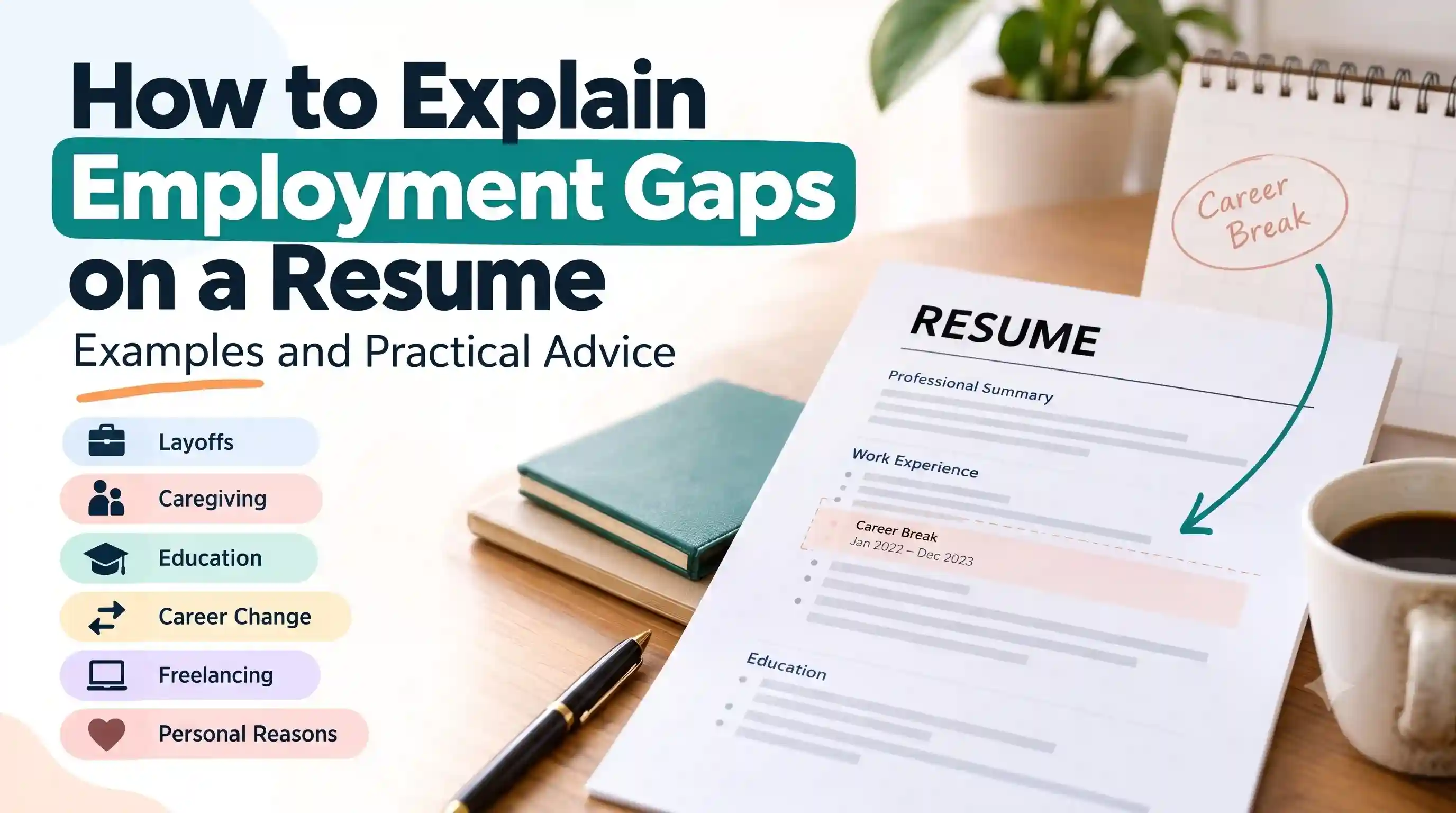
Looking at your resume and worrying about a gap between two jobs? You may be wondering whether a recruiter will question it, whether you need to explain it, or how much information you should include.
Employment gaps happen for many different reasons. Someone may spend time searching for a new job after a layoff, take a break to care for a family member, return to education, change careers, manage personal responsibilities, or simply take time away from work.
The challenge is deciding how to present that period without making the resume feel defensive or unnecessarily personal. In many cases, you do not need a long explanation. A clear timeline and a short, factual description can provide enough context.
This guide explains when an employment gap may need clarification, how to present different types of career breaks, and how to discuss your situation honestly while keeping your resume focused on your qualifications.
Important: You do not need to turn a career break into an achievement just to make it look impressive. The goal is to explain your timeline accurately and keep the focus on the experience and skills that are relevant to the role.
What Counts as an Employment Gap?
An employment gap generally refers to a period between jobs or a period when you were not working in a formal paid position. For example, you might have left one company in January and started your next job in September, leaving several months between the two roles.
A gap can also occur when you leave the workforce for a longer period because of education, caregiving, personal circumstances, a career change, or other reasons.
Not every period without a full-time job needs to be treated as a problem on your resume. You may have been freelancing, volunteering, studying, completing projects, or developing relevant skills during that time.
The important distinction is to describe those activities accurately. For example, freelance work can be listed as freelance work, and a course can be described as education or professional development. You should not present informal activity as employment if you were not actually employed.
Do You Need to Explain Every Employment Gap?
No. A resume does not need to provide a month-by-month explanation of your entire career history.
A short transition between two positions may be completely understandable from the dates on your resume. A longer period without formal employment, however, may benefit from a brief explanation when that context helps the reader understand your timeline.
Before adding an explanation, ask yourself whether it gives the reader useful information about your professional history. If the answer is no, you may not need a separate section at all.
For example, consider these two situations:
Short transition:
Software Developer — ABC Technologies
March 2025 - January 2026
Software Developer — XYZ Solutions
April 2026 - Present
A short period between roles does not necessarily require additional text. The dates already communicate the basic timeline.
For a longer break, a short entry can provide useful context:
Career Break
February 2025 - October 2025
Took time away from full-time employment for family responsibilities before returning to the workforce.
The explanation is intentionally brief. You can provide context without turning a resume into a detailed account of your personal circumstances.
What Should You Include When Explaining a Career Gap?
The amount of detail you include should depend on the reason for the gap and how relevant the activity during that period is to the job.
When appropriate, you can mention:
- The reason for the break in simple, professional language.
- Relevant education or training completed during the period.
- Freelance, consulting, volunteer, or project-based work.
- Professional skills you developed or maintained.
- The approximate period of the break.
You do not need to disclose sensitive personal details simply because there is a gap on your resume. Keep the explanation relevant to the professional context and use the available space to show what you can contribute to the role.
How to Explain Different Types of Employment Gaps
The best way to explain an employment gap depends on what happened during that period. There is no need to use the same wording for every situation. Keep the explanation truthful, brief, and relevant to your professional history.
Employment Gap After a Layoff
A layoff is different from leaving a job voluntarily. If your previous role ended because the company reduced its workforce, you do not need to present the situation as a personal failure or create a complicated explanation.
In many cases, simply listing the previous job and then continuing with your next relevant activity is enough. If the gap is long enough that additional context would help, you can use a short entry such as:
Career Transition
January 2026 - September 2026
Transitioned between roles following a company-wide workforce reduction while actively pursuing new software development opportunities.
You can also use the time to show genuine activities completed during the search, such as freelance work, relevant coursework, certifications, or personal projects.
Career Break for Caregiving
Some people step away from formal employment to care for a child, parent, partner, or another family member. You are not required to provide a detailed explanation of your family situation on your resume.
A simple description can be enough:
Career Break — Family Caregiving
March 2025 - December 2025
Took time away from full-time employment for family caregiving responsibilities before returning to the workforce.
If you completed relevant professional development during the break, you can mention it separately rather than trying to turn caregiving itself into a list of professional achievements.
Career Break for Personal or Health Reasons
You may also have taken time away from work because of personal circumstances or health-related reasons. You can keep the explanation general if you prefer.
Career Break
July 2024 - February 2025
Took a planned break from full-time employment for personal reasons and returned to active job searching in 2025.
You do not need to include private medical or family details on your resume unless there is a specific reason to do so.
Time Spent Studying or Upskilling
A period away from full-time employment can sometimes include formal education, certification preparation, structured training, or other professional development.
When that activity is relevant to the role you're applying for, give it its own entry instead of leaving the entire period unexplained.
Professional Development
January 2025 - August 2025
- Completed structured coursework in Java, Spring Boot, and SQL.
- Built small applications to practice REST API development and database integration.
This approach gives the reader useful context while making it clear that you were learning and building skills rather than holding a formal employment position.
Career Change
Some employment gaps happen because a person decides to move into a new field. A career change can require time for learning, portfolio work, training, or a focused job search.
Instead of hiding that period, you can show the relevant work that helped you move toward the new field.
Career Transition — Software Development
June 2025 - March 2026
- Completed hands-on training in JavaScript and React.
- Built portfolio projects to develop practical frontend development experience.
- Prepared applications for entry-level software development roles.
The key is to describe what actually happened. Don't rename a personal learning period as professional employment simply to remove a gap from the timeline.
Freelancing During an Employment Gap
A person may not have held a full-time position but may still have worked with clients, completed freelance assignments, or taken contract-based projects.
In that case, the freelance work can usually be presented as its own experience entry.
Freelance Web Developer
January 2025 - October 2025
- Built responsive websites for small businesses using HTML, CSS, and JavaScript.
- Communicated with clients to gather requirements and implement requested updates.
- Maintained deployed websites and resolved reported usability issues.
If the freelance work was occasional rather than continuous, describe it accurately rather than implying that you worked full-time throughout the entire period.
Starting a Business or Personal Venture
If you used part of your career break to start a business, build a product, or work independently on a venture, that experience may also be relevant to your resume.
Independent Product Project
February 2025 - November 2025
- Developed and launched a web application focused on resume creation and job-search preparation.
- Designed the frontend, implemented core product features, and maintained the application after launch.
Only use a title such as "Founder," "Product Developer," or "Independent Developer" when it accurately reflects your role. The same rule applies to any business or project you include on your resume.
How to Show an Employment Gap on Your Resume
You don't always need a separate "Employment Gap" section. In many cases, the cleanest approach is to keep your normal reverse-chronological work history and add a short entry only when the gap needs context.
For example:
Software Engineer
XYZ Technologies | 2023 - January 2025
- Developed internal web applications using React and JavaScript.
- Collaborated with backend developers to integrate REST APIs.
Career Break
February 2025 - November 2025
Took time away from full-time employment for family responsibilities.
Frontend Developer
ABC Solutions | December 2025 - Present
- Built responsive interfaces and reusable components for web applications.
- Worked with product and engineering teams to deliver new features.
This makes the timeline easy to follow without drawing unnecessary attention to the gap.
Use Clear Dates
Consistent dates make your employment history easier to understand. Pick one format and use it throughout the resume.
Recommended example:
January 2023 - March 2025
April 2025 - Present
Avoid switching between formats such as "01/2023," "Jan 2025," and "2025-04" unless there is a specific reason to do so.
Don't Hide Dates to Make the Gap Disappear
Some candidates remove months from their resume and show only years in an attempt to make employment gaps less visible.
While year-only dates can be appropriate in some resume formats, changing the date format solely to conceal a gap can make the timeline less clear. Use a consistent date format that accurately represents your experience.
What If You Did Relevant Work During the Gap?
An employment gap may look different when you were actively doing something relevant during that period. Freelancing, volunteering, consulting, coursework, certifications, open-source contributions, or personal projects can sometimes provide useful evidence of continued professional activity.
For example, instead of leaving an eight-month period completely blank:
Professional Development & Independent Projects
January 2026 - August 2026
- Completed structured training in React and Node.js.
- Built two portfolio projects to practice frontend development and REST API integration.
- Contributed bug fixes and documentation updates to an open-source project.
The important thing is not to fill every gap with activities simply to make the resume look busy. Include work that genuinely happened and is useful for understanding your preparation for the role.
If you're early in your career and have limited formal experience, our guide to writing a resume with no experience covers other ways to present projects, education, and relevant experience.
What Not to Say When Explaining an Employment Gap
An employment gap does not automatically require a long explanation. In many cases, a short and accurate description is enough. The goal is to give context without making the career break sound more complicated than it needs to be.
Avoid writing statements that sound defensive, apologetic, or overly personal. A resume should explain the timeline clearly while keeping the focus on your qualifications and experience.
Avoid apologizing for the gap
Phrases such as "Unfortunately, I was unemployed for two years" or "I could not find a job during this period" can make a normal career transition sound negative.
A better approach is to state what happened in a neutral way.
Less effective:
Unfortunately, I was unable to find employment for two years after losing my previous job.
Better:
Career Break — January 2023 to December 2024
Focused on professional development and preparing for opportunities in software development.
Avoid unnecessary personal details
You generally do not need to explain every personal circumstance behind a career break on your resume. Keep the information relevant to the professional context.
For example, if you took time away from work to deal with a family situation, a simple description such as "Family Caregiving — 2022 to 2023" can be enough. You do not need to include private family details.
Do not invent work to fill the gap
One of the worst ways to handle an employment gap is to create a job title, employer, project, or responsibility that did not actually exist.
A career break is easier to explain than inaccurate employment history. Employers may ask follow-up questions, and inconsistent information can damage trust.
Do not hide or manipulate dates
Removing months or changing dates simply to make an employment gap less visible can create another problem. Clear dates make your resume easier to understand and give recruiters an accurate timeline.
Should You Explain an Employment Gap in a Cover Letter?
You do not always need to mention an employment gap in a cover letter. Whether you should include it depends on how significant the gap is and whether the context helps explain your current career direction.
A cover letter can be useful when your career break is closely connected to the reason you are applying for the role. For example, someone returning to work after caregiving or someone moving into a new career field may benefit from briefly explaining the transition.
Keep the explanation short and connect it to your current goals.
Example:
After taking time away from full-time employment for family caregiving, I returned to professional development and focused on strengthening my skills in frontend development. I am now looking to apply those skills in a full-time software development role.
The important part is what comes next. After explaining the gap, move the reader's attention toward the experience, skills, and value you can bring to the position.
How to Explain an Employment Gap During an Interview
An interviewer may notice a gap and ask about it directly. This does not necessarily mean they view the gap negatively. They may simply want to understand your career timeline.
A strong answer is usually clear, honest, and brief. You can explain what happened, mention anything relevant you did during the period, and then bring the conversation back to your current career goals.
Example: layoff
My previous role ended as part of a company-wide reduction in workforce. I used the following period to strengthen my technical skills and look for a role that better aligned with my long-term career goals. I am now focused on finding a position where I can contribute those skills to a team.
Example: caregiving
I took a planned career break to support a family member who needed my attention. Once that responsibility became manageable, I returned my focus to my career and began preparing for full-time opportunities again.
Example: career change
I decided to take time away from my previous career to transition into software development. During that period, I focused on learning the technologies I needed, building projects, and preparing for roles in the field.
You do not need to memorize a complicated script. The most important thing is to be consistent with the information on your resume and comfortable explaining the timeline in your own words.
Tailor the Explanation to the Role You Are Applying For
The same employment gap can be presented differently depending on the position you are targeting. The underlying facts should remain accurate, but you can choose which relevant details to emphasize.
For example, someone who spent a career break learning frontend development can highlight those skills when applying for a frontend developer role. The same person may emphasize project management, communication, or business experience when applying for a different position.
Think of the explanation as supporting context rather than the main story of your resume. Your recent qualifications, relevant experience, and ability to perform the job should remain the primary focus.
Career change toward frontend development:
Career Break — 2023 to 2024
- Completed structured learning in modern frontend development.
- Built independent projects using React and JavaScript.
- Prepared for a transition into professional software development.
The explanation is more useful when it shows a clear connection between the time away from employment and the direction you are pursuing now.
Common Employment Gap Mistakes to Avoid
Most employment-gap problems are not caused by the gap itself. They are caused by unclear dates, unnecessary explanations, or a resume that leaves the reader unsure about what happened.
- Leaving dates unclear: Missing or inconsistent dates can make the timeline harder to follow.
- Overexplaining the situation: A resume is not the place for a long personal story.
- Using negative language: Avoid wording that makes the career break sound like something you need to apologize for.
- Inventing experience: Never create employment or responsibilities that did not happen.
- Ignoring useful work completed during the gap: Relevant projects, freelance assignments, courses, certifications, volunteering, or other genuine activities may strengthen your timeline.
- Making the gap the focus of the resume: The resume should still emphasize your skills, experience, achievements, and suitability for the role.
- Using the same explanation for every situation: Your description should reflect what you actually did and remain relevant to the position you are applying for.
Employment Gap Resume Checklist
Before submitting your resume, review the timeline and make sure the gap is presented clearly and honestly.
- Use clear and consistent employment dates.
- Decide whether the gap needs a brief explanation.
- Use a simple label such as Career Break, Caregiving, Education, or Independent Work when appropriate.
- Include relevant activities completed during the gap when they strengthen your application.
- Keep personal details limited to what is professionally relevant.
- Avoid apologetic or defensive wording.
- Do not invent employment or achievements.
- Make sure the explanation matches what you can comfortably discuss during an interview.
- Keep the focus on your current skills, experience, and the value you can bring to the employer.
A well-presented career timeline can make an employment gap feel like what it actually is: one part of a person's professional history rather than the defining feature of their resume.
Frequently Asked Questions About Employment Gaps on a Resume
Do I need to explain an employment gap on my resume?
Not necessarily. A short gap may not require a separate explanation, especially when the overall timeline is easy to understand. For a longer gap, a simple and honest description can provide useful context and make the timeline clearer.
How long of an employment gap should be explained?
There is no single length that automatically requires an explanation. Consider explaining a gap when it is long enough to make your career timeline unclear or when the context is relevant to your current career direction. Keep the explanation brief and factual.
Should I mention an employment gap caused by caregiving?
You can mention caregiving when it helps explain the timeline. You do not need to provide private family details. A simple entry such as Family Caregiving — 2022 to 2023 can provide enough context.
Should I mention a health-related career break?
You can choose how much personal information to disclose. A resume generally does not need detailed medical information. When an explanation is useful, a general description such as Personal Leave or Career Break can explain the timeline without revealing private details.
Can I include courses or personal projects during an employment gap?
Yes. Genuine courses, certifications, projects, freelance work, volunteering, or other relevant activities completed during the gap can be included when they demonstrate skills relevant to the position.
Should I hide an employment gap by using only years instead of months?
It is better to keep your dates accurate and consistent. Deliberately changing or hiding dates can make the timeline harder to understand. Use the same date format throughout your resume.
What is the best way to explain an employment gap in an interview?
Give a clear and honest explanation, keep it reasonably brief, mention relevant activities from the period when appropriate, and then bring the conversation back to your current skills and experience.
Can an employment gap be listed as experience?
A career break itself should not be presented as employment that did not occur. Genuine freelance work, consulting, independent projects, volunteering, education, or other activities can be included in the appropriate sections of your resume.
Conclusion
An employment gap does not have to become the central focus of your resume. What matters is presenting your career timeline clearly, keeping your dates accurate, and providing enough context for the reader to understand the transition.
Whether your break was caused by a layoff, caregiving, education, a career change, personal circumstances, freelancing, or another genuine reason, the same principle applies: explain only what is necessary, include relevant work or learning when it adds value, and avoid turning the explanation into a personal story.
Your resume should ultimately show where you are now and what you can contribute. A clearly presented career break is simply one part of that professional timeline.
Before submitting your resume, review the dates, make sure the information is accurate, and check that your explanation is consistent with what you would say during an interview.