Introduction
An internship can be one of the most useful experiences on a fresher's resume. It gives you practical experience to talk about, shows that you have worked in a real environment, and can help employers understand how you applied what you learned.
However, simply adding the company name and writing "Intern" is usually not enough. The internship section should help the reader understand what you actually worked on, what you contributed, and which skills you developed or used.
Many students also wonder where an internship belongs on a resume, whether it should be listed under Experience, what information should be included, and how to write bullet points when the internship was short or involved mostly learning.
In this guide, we'll look at how to add internship experience to a resume, where to place it, what details to include, and how to describe your work clearly without exaggerating your experience.
Important: Use only information that accurately represents what you actually did during your internship. Do not add technologies, responsibilities, or achievements simply because they appear impressive on a resume.
Should You Include an Internship on Your Resume?
In most cases, an internship is worth including when it is relevant to the type of role you are applying for. This is especially useful for students, recent graduates, and early-career candidates who may not have much full-time work experience yet.
An internship can provide evidence that you have worked on practical tasks, collaborated with others, followed a professional process, used tools related to your field, or contributed to a real project.
Relevance matters, though. An internship that is closely related to the position you're applying for can usually tell the recruiter more about your preparation for that role than an unrelated internship.
You also don't need to have completed a long internship for it to be useful. A short internship can still be worth mentioning when it gave you relevant experience or allowed you to work on something connected to your target role.
For example, a student applying for a frontend developer position may benefit from highlighting a software development internship where they worked with React, JavaScript, APIs, testing, or responsive interfaces. A candidate applying for a marketing role may instead emphasize an internship involving content, campaigns, research, analytics, or social media.
The goal is not to include every internship you've ever completed. The goal is to include the experiences that help explain why you are prepared for the job you're applying for.
Where Should You Put an Internship on a Resume?
There isn't one placement that works for every candidate. The best section depends on your overall experience, the number of internships you've completed, and how closely they relate to your target role.
For many freshers, an internship can be included in the Experience section, particularly when the internship involved meaningful responsibilities and work for an organization.
You can also create a separate Internship Experience section when you have multiple internships or when separating them makes your resume easier to scan.
For example:
Software Development Intern
ABC Technologies | Hyderabad, India
June 2026 - August 2026
- Built reusable React components for internal dashboard features.
- Fixed responsive layout issues across desktop and mobile views.
- Worked with developers to test and refine application features.
A separate internship section could look like this:
Software Development Intern
ABC Technologies | Hyderabad, India
June 2026 - August 2026
- Built reusable React components for internal dashboard features.
- Fixed responsive layout issues across desktop and mobile views.
- Worked with developers to test and refine application features.
Both approaches can be appropriate. Choose the structure that makes your most relevant experience easiest to find without making the resume unnecessarily complicated.
What Information Should an Internship Entry Include?
A good internship entry should be easy to scan. A recruiter should be able to identify your role, organization, and dates quickly before reading the details of your work.
In most cases, include the following:
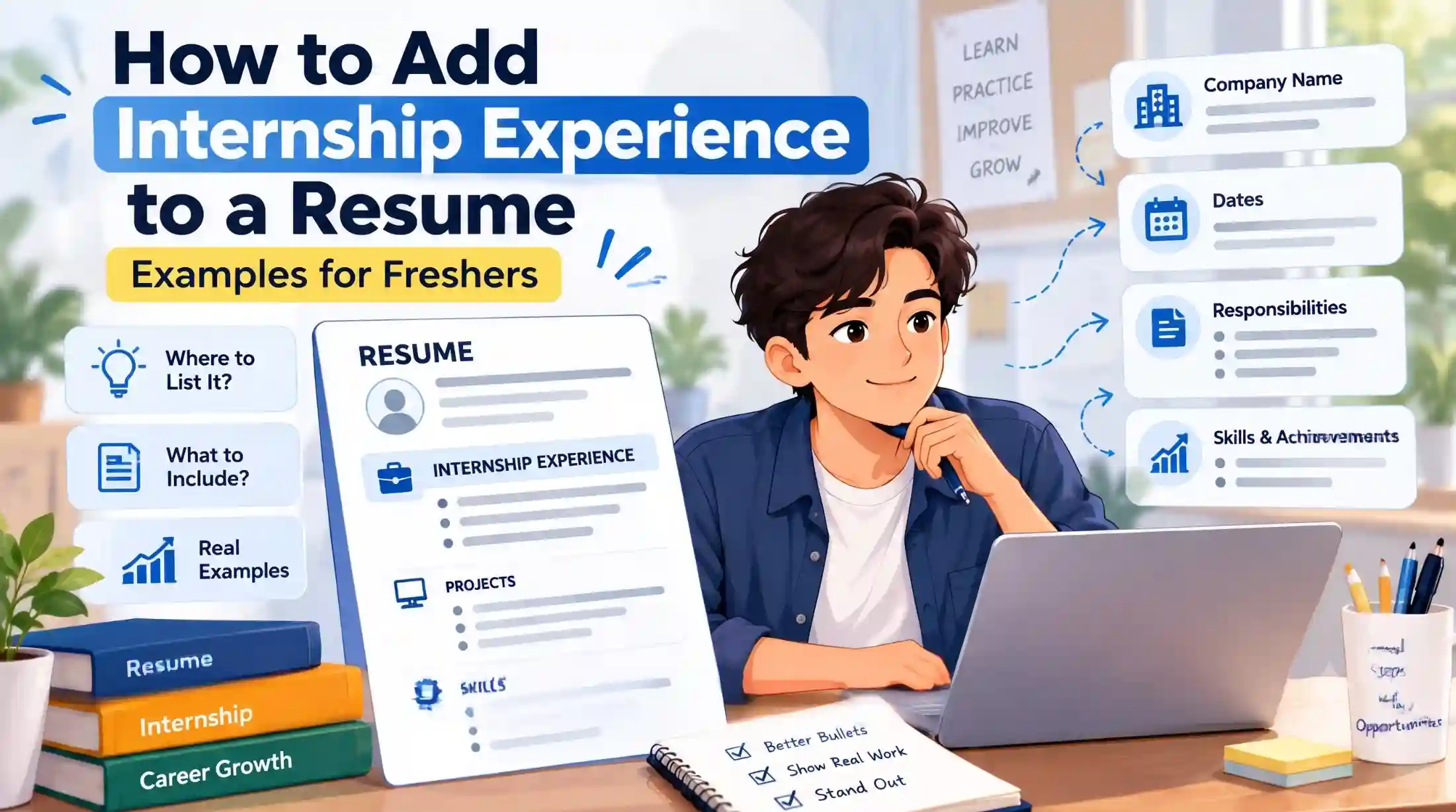
- Internship title or role
- Company or organization name
- Location or remote status, when useful
- Start and end dates
- Relevant responsibilities, contributions, or achievements
For example:
Data Analyst Intern
BrightData Solutions | Remote
January 2026 - March 2026
- Cleaned and organized sales data for weekly reporting tasks.
- Created spreadsheet-based summaries to help track monthly trends.
- Assisted with preparing charts and reports for internal reviews.
You don't need to describe every activity you performed during the internship. Focus on work that helps the reader understand your responsibilities, skills, and contribution.
How to Write Strong Internship Bullet Points
The bullet points are usually the most important part of an internship entry because they explain what you actually did. A good bullet should give the reader enough context to understand your contribution without turning the resume into a detailed internship report.
A useful way to think about an internship bullet is: action + task + context + result. You don't need every element in every bullet, but this structure can help you move beyond vague descriptions.
For example, instead of writing:
Weak: Worked on a website using React.
You could make it more specific:
Better: Built reusable React components for an internal web application and fixed responsive layout issues across desktop and mobile screens.
The second version tells the reader what the candidate worked on, the technology involved, and the type of contribution they made.
Our guide on how to write strong resume bullet points goes deeper into writing concise and specific resume bullets.
Start With an Action Verb
Strong internship bullets usually begin with a clear action. Words such as built, developed, analyzed, designed, tested, created, organized, researched, and assisted can help make the contribution easier to understand.
Compare these two examples:
Less specific: Responsible for testing application features.
More specific: Tested new application features and reported functional issues during development reviews.
The second example describes the actual activity rather than beginning with a generic phrase such as "Responsible for."
Explain What You Actually Contributed
Internship work can range from building features to preparing reports, assisting a team, conducting research, organizing information, or supporting day-to-day operations. Don't feel that every bullet needs to describe a major achievement.
A contribution can still be useful when it clearly explains the work you performed.
For example:
- Assisted the finance team in preparing monthly expense reports and organizing supporting documents.
- Researched competitor products and summarized findings for weekly marketing discussions.
- Created spreadsheet-based reports to organize and track project information.
These examples don't rely on impressive-sounding claims. They simply make the candidate's work easier to understand.
Add Results When You Have Genuine Evidence
A measurable result can make an internship bullet more informative, but you should never invent numbers just to make the experience appear more impressive.
For example, if you actually helped prepare a report used by 5 departments, processed 2,000 records, or reduced a measured task from 30 minutes to 20 minutes, those numbers may provide useful context.
Without a result: Organized customer records and prepared weekly reports.
With a genuine result: Organized more than 2,000 customer records and prepared weekly reports used by the sales team to track account activity.
If you don't have a reliable metric, don't manufacture one. You can still write a strong bullet by describing the task, your contribution, the tools you used, or the outcome that you can genuinely support.
Show Skills Through the Work
Your internship section can naturally demonstrate skills without turning every bullet into a list of keywords.
Instead of writing:
Skills: React, JavaScript, Git, APIs
you can show how those skills were actually used:
- Developed reusable React components using JavaScript for internal application features.
- Integrated REST API responses into frontend components and tested common error scenarios.
- Used Git for version control and collaborated with team members through feature branches and pull requests.
This gives the reader evidence of how the skills were applied instead of simply repeating a list from the Skills section.
Internship Resume Examples by Field
The best way to describe an internship depends heavily on the type of work you performed. A software development intern and a marketing intern may both have completed valuable internships, but their resume entries should highlight very different contributions.
Software Development Internship
Software Development Intern
TechNova Solutions | Bengaluru, India
May 2026 - July 2026
- Developed reusable React components for internal web application features.
- Integrated frontend components with REST APIs and handled common loading and error states.
- Fixed responsive UI issues and tested application changes before release.
Data Analytics Internship
Data Analytics Intern
InsightWorks | Hyderabad, India
January 2026 - March 2026
- Cleaned and organized sales data for recurring reporting tasks.
- Prepared spreadsheet-based summaries to identify monthly sales trends.
- Assisted in creating charts and reports used during internal performance reviews.
Marketing Internship
Marketing Intern
BrightPath Media | Remote
June 2026 - August 2026
- Researched competitor campaigns and summarized findings for weekly marketing meetings.
- Assisted with social media content planning and campaign preparation.
- Organized campaign performance data and helped prepare weekly reporting summaries.
Finance Internship
Finance Intern
Vertex Financial Services | Chennai, India
April 2026 - June 2026
- Assisted with preparing monthly financial reports and organizing supporting documents.
- Updated spreadsheet records and checked entries for common data inconsistencies.
- Supported the team in preparing information for internal review meetings.
Human Resources Internship
Human Resources Intern
PeopleFirst Consulting | Pune, India
February 2026 - April 2026
- Assisted with organizing candidate information and interview schedules.
- Maintained recruitment records and updated candidate status reports.
- Helped prepare onboarding documentation for new employees.
These examples are only illustrations. Your own bullets should reflect the tasks, tools, responsibilities, and results that actually describe your internship.
How to Add a Short Internship to Your Resume
A short internship does not need to be hidden simply because it lasted a few weeks. What matters is whether the experience is relevant and whether you have enough meaningful work to describe.
For a short internship, focus on the strongest contributions rather than trying to make the experience appear longer than it was.
Frontend Development Intern
WebCraft Labs | Remote
June 2026 - July 2026
- Built reusable UI components using React for internal application screens.
- Fixed cross-device layout issues and tested changes across common viewport sizes.
Two strong bullets that accurately describe a short internship are more useful than filling the section with repetitive statements about what you learned.
How to List an Ongoing Internship
If your internship is still in progress, you can list the start date followed by Present.
Software Engineering Intern
ABC Technologies | Hyderabad, India
June 2026 - Present
- Developing frontend features using React and JavaScript for internal web applications.
- Participating in code reviews, testing, and regular development discussions with the engineering team.
When an internship is ongoing, describe work that you have already completed or are currently performing. Avoid presenting planned future responsibilities as achievements.
Internship vs. Project: What's the Difference?
Freshers sometimes have both internship experience and academic or personal projects, and it can be difficult to decide how to present them on a resume. The easiest approach is to keep the two types of experience clearly separated.
An internship represents work or training performed for an organization. A project can be academic, personal, open-source, or completed as part of coursework or a self-directed learning effort.
For example, if you completed an internship where you contributed to a company's internal application, you can list that experience under Internship Experience or Experience. If you built your own expense tracker using React and Firebase, that would normally belong in a Projects section.
INTERNSHIP EXPERIENCE
Frontend Development Intern
ABC Technologies | Remote
June 2026 - August 2026
- Developed reusable React components for internal application screens.
- Fixed responsive UI issues and tested changes across multiple viewport sizes.
PROJECTS
Expense Tracker
React, Firebase
- Built a web application for recording, categorizing, and reviewing personal expenses.
- Added authentication and cloud data storage using Firebase.
Keeping these experiences separate makes your background easier to understand and prevents you from presenting a personal project as professional employment.
If you're looking for project ideas to strengthen a fresher resume, our project ideas for freshers guide provides examples of projects you can explore based on your interests and field.
How to List Unpaid, Remote, or College Internships
The fact that an internship was unpaid, remote, or arranged through your college does not automatically make it unsuitable for a resume. The same basic principle applies: describe the experience honestly and focus on the work that is relevant to the position you're targeting.
Unpaid Internship
You generally do not need to emphasize whether an internship was paid or unpaid unless that information is specifically relevant to the application.
Instead, use the available space to describe the responsibilities, projects, tools, and contributions that demonstrate what you gained from the experience.
Remote Internship
A remote internship can be presented in the same way as an in-person internship. You can include Remote as the location when it helps clarify the arrangement.
Content Writing Intern
CareerHub Media | Remote
May 2026 - July 2026
- Researched career topics and drafted articles based on editorial guidelines.
- Edited article drafts for clarity, structure, grammar, and consistency.
College or University Internship
If your internship was arranged through your college or university, you can still list the organization where you actually completed the internship along with your role and dates.
Avoid adding unnecessary explanations about how the internship was arranged unless they provide useful context for the role you're applying for.
Can You Add an Internship Without a Certificate?
A certificate is not what makes an internship experience valuable on a resume. What matters is whether the experience is genuine and whether you can accurately describe the work you performed.
If you completed an internship but were not given a formal certificate, you can still include the experience when you have legitimate details about the organization, role, dates, and work you completed.
For example, you might have an internship offer email, project documentation, code contributions, reports, or other evidence of the work. You do not need to create a certificate or make an unsupported claim simply to make the internship look more formal.
The same principle applies to internships listed on your resume: only include experiences that you can genuinely explain and support.
Common Internship Resume Mistakes
Even when an internship is genuinely useful, the way it is presented can make the section less effective. Watch out for these common mistakes.
1. Writing Only What You Learned
Saying that you "learned React," "learned marketing," or "learned financial analysis" doesn't tell the reader what you actually did.
Less useful: Learned React and JavaScript during my internship.
More useful: Developed reusable React components and fixed UI issues in an internal web application.
Learning is a natural part of an internship, but your resume should focus on the practical work through which you gained that experience.
2. Copying the Internship Description
Avoid copying the company's internship description word for word. Describe the work you actually performed instead.
3. Listing Every Small Task
You don't need to document everything you did during the internship. Select the tasks that are most relevant to the job you're applying for.
4. Adding Skills You Barely Used
Don't turn a short exposure to a technology into a claim that you are highly proficient in it. Your resume should reflect your actual level of experience.
5. Inventing Numbers
Metrics can be useful when they are genuine, but adding unsupported numbers can make an otherwise honest resume misleading.
6. Making Every Bullet Sound Like an Achievement
Not every internship task produces a dramatic result. It is perfectly acceptable to describe a meaningful responsibility clearly rather than forcing every bullet into an exaggerated achievement statement.
7. Making the Internship Too Long
An internship does not need six or seven bullets simply because you have more things you could mention. Keep the strongest and most relevant points and give other sections enough space.
How to Tailor Your Internship Experience for a Job
The same internship can be presented differently depending on the role you're applying for. You don't need to change the facts, but you can decide which genuine parts of the experience deserve the most attention.
For example, imagine a software development internship where you worked on frontend components, API integration, testing, and documentation.
For a frontend developer position, you might emphasize:
- Developed reusable React components for internal application screens.
- Fixed responsive UI issues across desktop and mobile layouts.
For a role that emphasizes APIs and backend collaboration, you might give more attention to:
- Integrated REST API responses into frontend features and handled common loading and error states.
- Worked with developers to test and troubleshoot application integration issues.
The important part is that both versions describe the same underlying experience. Tailoring should help relevant information become easier to find; it should not change what you actually did.
This approach also works well when you're applying for several related roles. Review the job description, identify the most relevant requirements, and make sure your genuine experience supporting those requirements is easy to see.
For a more detailed process, see our guide to tailoring your resume to a job description .
Internship Resume Checklist
Before submitting your resume, take a final look at the internship section and check the following:
- The role is clearly identified.
- The company or organization name is easy to find.
- The internship dates are clear and consistent.
- Your bullets describe actual work you performed.
- The most relevant responsibilities are emphasized.
- Technologies and skills listed are genuine.
- Metrics are included only when you can support them.
- The section is concise enough to keep the resume readable.
- The experience is tailored to the role without changing the facts.
If you have very little formal experience beyond an internship, don't worry about trying to make the internship look like several years of employment. A clearly presented internship, combined with relevant projects, education, skills, and other experience, can provide a solid foundation for a fresher resume.
If you're building a resume without any professional experience yet, our guide to writing a resume with no experience covers other ways to present your background.
Frequently Asked Questions
Should I include an internship if I have no full-time experience?
Yes. An internship can be especially useful when you have limited professional experience because it gives you an opportunity to show practical work, responsibilities, and skills related to the type of role you're targeting.
Should I put an internship under Experience or Internships?
Either can work. If the internship involved meaningful professional responsibilities, you can include it under Experience. If you have multiple internships or want to clearly separate them from other employment, a dedicated Internship Experience section can also make sense.
How many bullet points should an internship have?
There is no fixed number that works for every internship. In many cases, two to four strong and relevant bullet points are enough for a short internship. Focus on the work that best demonstrates your preparation for the role rather than trying to describe everything you did.
Should I include an unpaid internship on my resume?
Yes, when it is relevant and represents genuine experience. Whether the internship was paid or unpaid usually matters less than what you actually worked on and how clearly you present that experience.
Can I include a remote internship on my resume?
Yes. A remote internship can be presented in the same way as an in-person internship. You can include "Remote" as the location when it helps clarify the arrangement.
Can I list an internship without a certificate?
Yes. A certificate is not the only evidence of an internship. If the experience is genuine and you can accurately describe the organization, dates, role, and work you performed, you can include it on your resume.
Should I mention everything I learned during my internship?
Not necessarily. Focus on the practical work you performed and the skills you actually used. You can mention learning outcomes when they are relevant, but a resume is generally more useful when it shows how you applied those skills rather than simply listing what you studied.
Should I add numbers to my internship bullet points?
Add measurable results when you have genuine numbers that you can support. Metrics can make a bullet more specific, but they should never be invented simply to make an internship appear more impressive.
Can I include an internship that is not related to the job?
You can, especially when you have limited experience, but consider how much space it deserves. Prioritize internships and other experiences that help demonstrate skills or responsibilities relevant to the role you're applying for.
Conclusion
An internship can add useful evidence to a fresher resume, but the experience becomes much more valuable when it is presented clearly. Instead of simply listing the organization and your role, explain what you actually worked on and how that experience relates to the type of position you're applying for.
Start with the basic details: your internship title, organization, and dates. Then use a few concise bullet points to describe your responsibilities, contributions, tools, and genuine results where applicable.
Keep the information accurate. Don't add technologies you only briefly encountered, don't turn routine responsibilities into exaggerated achievements, and don't invent numbers to make the experience sound stronger.
If you have both internships and projects, use each section to show a different type of experience. An internship can demonstrate experience working with an organization, while projects can show what you have built or explored independently.
Finally, tailor the most relevant parts of your internship experience to each job without changing the truth about your background. A clear, specific, and honest internship section can make it easier for a recruiter to understand what you bring to an entry-level role.
When your resume is ready, you can use ResumeInator's free resume templates to organize your experience and create your final document.
You can also review your finished resume using the ResumeInator ATS Resume Scanner as an additional review step before submitting applications.