Introduction
Choosing a resume format can seem like a small decision, but it affects how recruiters understand your professional background. The same education, skills, and experience can appear quite different depending on how you organize them.
Perhaps you're a fresher applying for your first job. Maybe you have several years of experience and want to show your career progression. Or you might be changing industries, returning to work after a career break, or trying to make skills from different roles more visible. Each situation can call for a slightly different approach to presenting your qualifications.
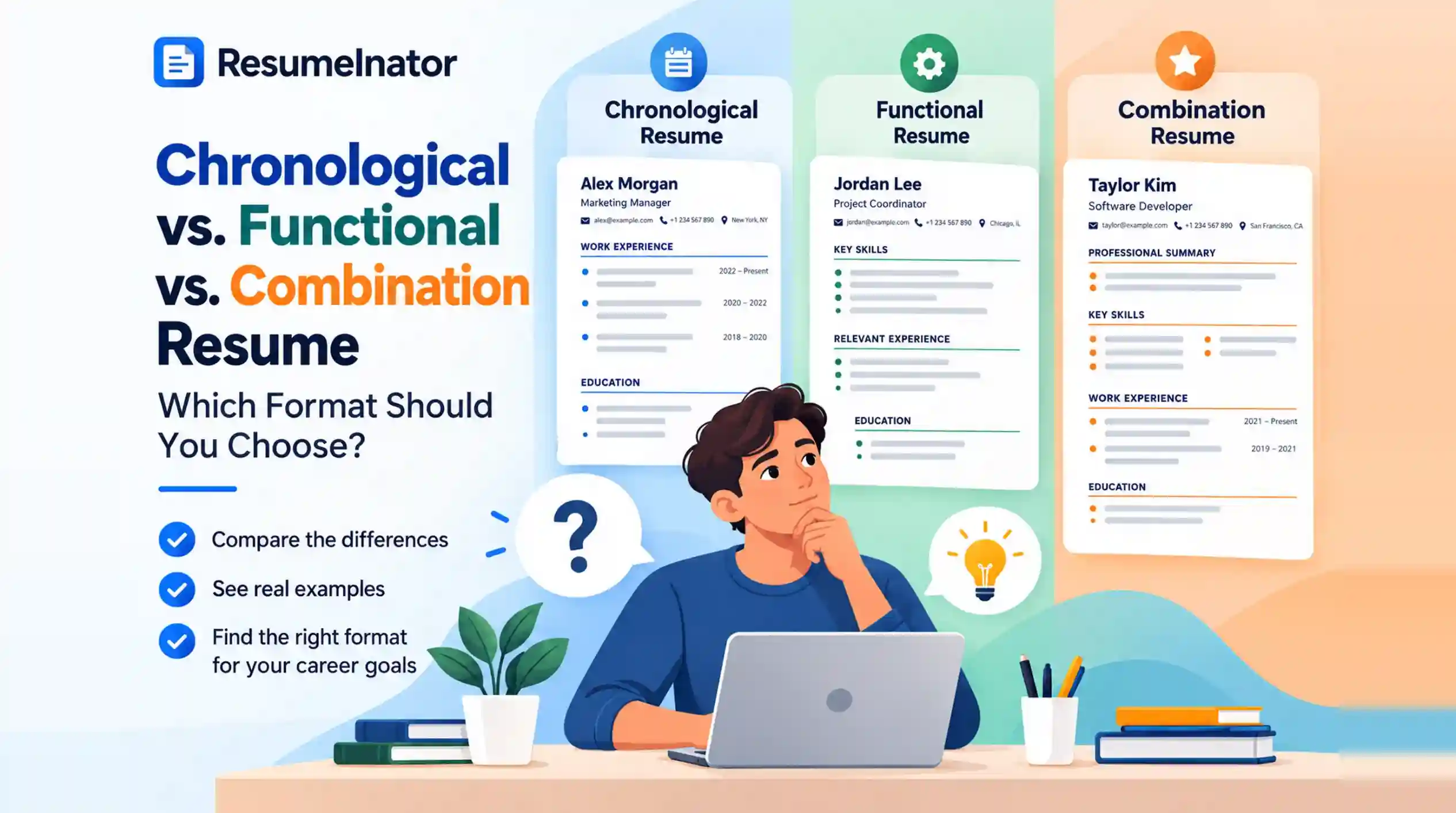
Three common resume formats are the chronological resume, the functional resume, and the combination resume. They organize professional information differently, and each has advantages and limitations.
In this guide, we'll compare these formats using practical examples, explain when each one may be appropriate, and help you decide which structure fits your actual experience and the roles you want to pursue. We'll also cover readability and Applicant Tracking System (ATS) considerations without assuming that one format works best for every employer or application.
Understanding the Three Main Resume Formats
A resume format describes how you organize and present information about your qualifications. It determines how prominently you show your work history, skills, achievements, and other relevant details.
Although resume layouts can vary, the three commonly discussed formats are:
- Chronological resume: Organizes your work experience primarily by date, usually with your most recent position first.
- Functional resume: Groups information around skills and areas of expertise, placing less emphasis on a detailed, position-by-position employment history.
- Combination resume: Brings skills and relevant achievements to the forefront while still presenting a structured work history.
The term chronological resume is often used casually to refer to what is more precisely called a reverse-chronological resume. In this format, your latest role appears first, followed by earlier positions. That is the version this article discusses.
These formats are not three completely separate sets of rules. You can adjust section order, emphasize relevant experience, and adapt the structure to your circumstances while keeping the document clear and accurate.
The best starting point is to consider what a recruiter needs to understand about your background and how easily your resume can communicate that information.
1. Chronological Resume Format
A chronological resume presents your professional experience in reverse-chronological order, beginning with your most recent position. Each role normally includes the employer, job title, dates of employment, and a description of your responsibilities or achievements.
This format makes the sequence of your employment easy to follow. A recruiter can see where you've worked, how your responsibilities have changed, and whether your recent experience is relevant to the position you're applying for.
What does a chronological resume look like?
WORK EXPERIENCE
Frontend Developer
ABC Technologies | January 2024 - Present
- Developed reusable React components for customer-facing applications.
- Collaborated with designers and backend developers to deliver responsive application features.
Junior Web Developer
XYZ Solutions | July 2022 - December 2023
- Built and maintained website interfaces using HTML, CSS, and JavaScript.
- Assisted with debugging, responsive layouts, and application testing.
This is an illustrative example. The newest role appears first, making the candidate's career progression straightforward to understand.
Advantages of a chronological resume
- Clear employment timeline: Recruiters can quickly understand the order and duration of your previous roles.
- Shows career progression: Promotions, increasing responsibility, and movement into more specialized roles are easier to demonstrate.
- Highlights recent experience: Your current or latest work appears near the beginning of the experience section.
- Familiar structure: The format follows an organization commonly used in professional resumes, making the information straightforward to review.
Limitations of a chronological resume
- Gaps may be more visible: Periods without employment can be easier to notice in the timeline. This does not automatically make the resume weaker, but you may need to decide whether a brief explanation would help.
- Less relevant recent experience can dominate: If your latest roles are unrelated to your target job, the recruiter may see that experience before discovering your transferable skills.
- Limited direct work history can leave the section short: Freshers or people returning to work may have fewer positions to include, so they may need to give greater prominence to education, projects, training, or other relevant experience.
Who should choose a chronological resume?
This format is often a good starting point for professionals whose previous positions are relevant to their target role and whose work history helps demonstrate their qualifications.
For example, an accountant applying for another accounting position can use the format to highlight recent accounting experience and increasing responsibility. An experienced software developer can use it to show progression from junior development work to more senior responsibilities.
It can also work well for candidates with stable employment histories who want to make their recent achievements easy to find.
However, you do not need a perfectly uninterrupted career history to use this format. If your experience is relevant, a chronological structure can still be effective even when the timeline includes a genuine career break or a change of employer.
2. Functional Resume Format
A functional resume organizes information primarily around skills, abilities, and areas of expertise rather than presenting a detailed, position-by-position employment history as the main focus.
Instead of immediately emphasizing where and when you worked, this format groups relevant abilities into categories. For example, a candidate might organize their resume around technical skills, project coordination, customer communication, or data analysis.
The employment history section is generally shorter than in a chronological resume. However, an accurate employment history should still be provided when relevant or requested by the employer. A functional resume should not be used to misrepresent employment dates or conceal information an application specifically asks for.
What does a functional resume look like?
PROFESSIONAL SUMMARY
Web development professional with experience in frontend technologies, responsive interfaces, and application debugging.
TECHNICAL SKILLS AND ACHIEVEMENTS
Frontend Development
- Built responsive user interfaces using React, JavaScript, HTML, and CSS.
- Created reusable components to support consistent application layouts.
Problem Solving and Testing
- Investigated interface defects and helped resolve application issues.
- Tested components and checked behavior across different screen sizes.
WORK HISTORY
Frontend Developer — ABC Technologies, January 2024 - Present
Junior Web Developer — XYZ Solutions, July 2022 - December 2023
This example groups capabilities into skill categories before listing employment history. The content is illustrative; actual skills and achievements should reflect the candidate's own experience.
Advantages of a functional resume
- Emphasizes relevant skills: Candidates can highlight useful abilities even when those abilities were developed across several different roles or activities.
- Can support a career transition: Someone moving into a different field may want to make transferable skills visible before presenting experience from an unrelated industry.
- Accommodates varied experience: Skills gained through employment, projects, volunteering, training, and other genuine activities can be organized around relevant strengths.
- Offers an alternative emphasis: When job titles alone do not communicate a candidate's relevant abilities, a skills-focused structure may help explain them.
Limitations of a functional resume
- Career progression may be less obvious: Recruiters may find it harder to understand how responsibilities changed over time when the work history receives less emphasis.
- Skills can lack context: Without clear information about where a skill was used, it may be difficult to judge the candidate's level of experience or personal contribution.
- The timeline may require closer review: Readers who want to understand employment dates and job history may have to look in a separate section.
- It does not automatically solve an employment gap: Changing the order of information does not remove a gap from the candidate's actual career history. An accurate timeline remains important.
Who should consider a functional resume?
A functional format may be worth considering when your relevant skills are more informative than a sequence of job titles. This can include some career changers, candidates with varied experience, or people whose strongest qualifications come from several different kinds of activity.
However, it is not automatically the best option for everyone returning to work or dealing with an employment gap. A conventional employment timeline combined with a clear explanation of relevant skills may be more useful when employers need to understand both your experience and your career history.
Before choosing a functional format, consider whether it makes your qualifications easier to understand or merely makes the employment timeline harder to follow.
3. Combination Resume Format
A combination resume, sometimes called a hybrid resume, brings together elements of the chronological and functional formats. It highlights relevant skills and achievements while retaining a structured work history.
This format can be useful when you have strong skills to emphasize but also want recruiters to see where you gained your experience and how your career developed.
A typical combination resume begins with a professional summary or skills section, followed by work experience in reverse-chronological order. The exact organization depends on the candidate's background and the requirements of the target role.
What does a combination resume look like?
PROFESSIONAL SUMMARY
Frontend developer experienced in building responsive web applications, developing reusable React components, and collaborating with cross-functional teams.
CORE SKILLS
- React and JavaScript development
- Responsive user interface development
- Reusable component design
- Debugging and application testing
WORK EXPERIENCE
Frontend Developer
ABC Technologies | January 2024 - Present
- Developed reusable React components for customer-facing applications.
- Collaborated with design and backend teams to deliver responsive features.
Junior Web Developer
XYZ Solutions | July 2022 - December 2023
- Built website interfaces using HTML, CSS, and JavaScript.
- Supported debugging, responsive layouts, and application testing.
Notice how this format gives the reader an early overview of the candidate's relevant capabilities, then provides the employment history needed to understand the experience behind those skills.
Advantages of a combination resume
- Balances skills and employment history: Relevant capabilities receive attention without removing the context of previous positions.
- Supports career transitions: Transferable skills can be highlighted while previous employment remains visible and accurately described.
- Works with varied professional backgrounds: Candidates can bring together relevant skills, achievements, and experience from different roles without relying entirely on one section.
- Allows focused presentation: The structure can be adjusted so the most relevant qualifications appear early without repeating the same achievements throughout the resume.
Limitations of a combination resume
- It can become too long: Including a detailed skills section and a full employment history may lead to repetition if both sections describe the same work in similar terms.
- It requires careful organization: Readers should be able to move naturally from the candidate's main strengths to the evidence supporting them.
- It is not suitable for every situation: A candidate with limited relevant material may not benefit from adding multiple sections simply to create a more elaborate format.
Who should choose a combination resume?
A combination resume is a strong option to consider when you have relevant skills worth highlighting and enough experience to support them with concrete examples.
For example, a professional moving from customer support into project coordination could highlight planning, communication, documentation, and issue resolution before describing previous roles. A developer applying for a more specialized position could emphasize relevant technologies and achievements before presenting the complete work history.
The goal is to connect skills with evidence. A skills section should help the reader understand what you can do, while the employment history shows the context in which you developed and applied those abilities.
Chronological vs. Functional vs. Combination: Side-by-Side Comparison
The main difference between these formats is how they prioritize information. Use the comparison below as a starting point, rather than as a rigid rule about which format every candidate must use.
| Factor | Chronological | Functional | Combination |
|---|---|---|---|
| Primary emphasis | Employment history and career progression | Skills and areas of expertise | Skills plus employment history |
| Work history | Detailed and prominent | Usually less prominent | Detailed, with skills featured earlier |
| Career progression | Easy to follow | May be less obvious | Visible alongside relevant skills |
| Career change | Can work when previous experience is relevant | Can emphasize transferable skills | Can connect transferable skills with previous roles |
| Employment gaps | Gaps may be easier to notice | Timeline may receive less visual emphasis | Gaps remain visible, with skills highlighted separately |
| Potential challenge | Unrelated recent experience may dominate | Employment timeline may be harder to understand | Skills and experience may become repetitive |
None of these formats is universally superior. The right choice depends on the evidence you have, how relevant your experience is to the role, and how clearly you can present your qualifications.
Which Resume Format Is Best for Your Career Situation?
The right resume format depends on what you need the employer to understand about your background. Your years of experience matter, but they are not the only factor. The relevance of your previous roles, the skills you have developed, and the evidence available to support your qualifications all influence which structure makes sense.
For freshers and recent graduates
If you are applying for your first full-time position, you may not have an extensive employment history to present. That does not mean you need to hide the absence of professional experience or force your resume into a functional format.
A simple chronological structure can still work when you have relevant internships or part-time employment. You can also place education, projects, technical skills, and certifications before work experience when those sections provide stronger evidence of your suitability for the role.
For example, a recent graduate applying for a junior software development role might organize the resume as follows:
- Contact information
- Professional summary, if useful
- Technical skills
- Projects
- Education
- Internships or other experience
The order can change depending on the candidate's strongest qualifications. If an internship is directly relevant to the target position, it may deserve more prominence than academic projects.
If you are starting from scratch, our guide to writing a resume with no experience explains how to present your education, skills, projects, and other genuine experience.
For experienced professionals
If your recent work closely matches the position you want, a reverse-chronological resume is usually a sensible starting point. It allows the recruiter to see your latest responsibilities, relevant achievements, and career progression without having to search through several skill categories.
A combination format may be more useful when you have several specialized skills or achievements that deserve attention near the beginning of the document.
Consider a software developer applying for a senior frontend role. A concise skills section can highlight React, JavaScript, component architecture, and performance optimization. The following employment section can then demonstrate where those skills were applied and what the developer contributed.
Avoid listing every skill you have encountered. Focus on the capabilities that are relevant to the target role and support them with evidence from your work.
For career changers
A career change can make the choice less straightforward. Your most recent job may not be in your desired field, but it may still contain transferable skills that matter to the new position.
A combination resume can help connect these two parts of your background. It lets you introduce relevant capabilities early while retaining the employment history needed to explain where your experience came from.
Target role: Project Coordinator
Previous background: Customer Support Specialist
Relevant transferable skills:
- Coordinating work across multiple teams
- Tracking issues and following up on unresolved tasks
- Maintaining documentation and communicating updates
- Prioritizing requests and managing competing deadlines
The candidate can highlight these capabilities in a skills section, then use work experience to explain where and how they were developed.
The important distinction is between having transferable skills and claiming experience you do not have. Your resume should explain the connection honestly rather than making your previous role appear to have been a different job.
For candidates with an employment gap
An employment gap does not automatically mean you should choose a functional resume. If your previous positions remain relevant, a reverse-chronological format may still be the clearest way to present your experience.
You can briefly identify a career break when doing so helps explain the timeline. You can also include relevant education, freelance work, projects, or other genuine activities completed during the period.
The objective is not to make the gap disappear. It is to present an accurate career history and help the reader understand your current qualifications.
Our guide to explaining employment gaps on a resume covers practical ways to describe different types of career breaks.
For freelancers and candidates with varied experience
Freelancers, consultants, and independent professionals may have worked with several clients or completed projects that do not fit neatly into a traditional employer-by-employer timeline.
A combination format can be helpful when you want to highlight a particular area of expertise while still showing the timeline and context of your work. A chronological structure can also work well if you organize your freelance or consulting activity as a clearly dated professional engagement.
For example, a freelance designer might create a concise portfolio or selected-projects section, followed by a clearly dated Freelance Designer entry with relevant clients and responsibilities where disclosure is appropriate.
Choose the structure that makes your contribution easiest to understand. Do not split the same project across several sections simply to make the resume appear longer.
Which Resume Format Is Best for ATS?
There is no single resume format that guarantees the best result with every Applicant Tracking System (ATS). Employers use different systems and configure them for different recruitment processes. How a resume is parsed or reviewed can depend on the document structure, content, software, and employer workflow.
Rather than choosing a format based only on claims about ATS compatibility, focus on making your information clear, consistent, and easy to interpret.
Use recognizable section headings
Headings such as Work Experience, Education, Skills, Certifications, and Projects help readers understand the purpose of each section. Creative alternatives can be appropriate in some contexts, but clear conventional labels are generally a sensible choice when compatibility is a priority.
Keep the layout easy to follow
Use a consistent reading order, clear spacing, and a logical section hierarchy. Overly complicated layouts can make it more difficult for readers to locate important information and may create extraction problems in some systems.
Multi-column layouts, text boxes, tables, graphics, and decorative elements are not guaranteed to cause ATS problems in every system. However, a simpler structure is often a practical choice when you do not know how a particular employer's software will process the file.
Make dates and job details consistent
Present job titles, employer names, and employment dates in a consistent way. For example, if one position uses a month-and-year date range, avoid switching randomly between different date formats elsewhere in the same document.
Keep the employment timeline accurate regardless of which resume format you choose. A skills-focused section should not replace necessary work-history information or obscure dates that employers need to evaluate.
Follow the employer's file instructions
If the job application requests a PDF or DOCX file, follow those instructions. A text-based document with selectable content is generally preferable to a scanned image of a resume when the employer needs software to extract information.
Before submitting your file, open the exported document and check that the text, dates, headings, and bullet points appear in the intended order. A resume that looks correct in an editor can still have export issues worth catching before submission.
You can also use our explanation of how ATS scanners work to understand resume parsing and the differences between recruitment systems.
Common Resume Format Mistakes to Avoid
Selecting a format is only part of creating a useful resume. Even a suitable structure can become ineffective when information is disorganized, repetitive, or difficult to verify.
Choosing a format because it supposedly hides weaknesses
A functional resume is not a reliable way to make an employment gap disappear, and a combination resume cannot compensate for missing evidence of relevant skills. Choose a structure that communicates your background honestly rather than one intended to obscure information.
Using too many sections
Adding separate sections for every skill category, achievement, project, and responsibility can make the resume longer without making it more informative. Include sections that help demonstrate your suitability for the target role.
Repeating the same achievements
Combination resumes are especially vulnerable to repetition. If your skills section already highlights a specific achievement, use the experience section to provide the role, context, or additional detail rather than copying the same description word for word.
Giving irrelevant experience too much space
Your employment history can be accurate without giving every role the same level of detail. Expand on recent or relevant experience, and summarize older or less relevant positions when appropriate.
Changing the format without considering the job description
A resume that works well for one position may not be the strongest choice for another. Review the job description, identify the qualifications it emphasizes, and organize your resume so the most relevant evidence is easy to find.
Our guide to tailoring a resume to a job description explains how to adapt the content to a particular opportunity without inventing qualifications or experience.
Assuming a format can guarantee an interview
No resume format can guarantee that you will pass an employer's screening process or receive an interview. The format helps organize information; your actual qualifications, relevant experience, the application requirements, and the employer's hiring process also influence the outcome.
How to Choose the Right Resume Format: A Practical Decision Guide
If you are still undecided, answer the following questions in order. The goal is to choose a format that makes your strongest qualifications clear without making the rest of your background difficult to understand.
Step 1: Identify your strongest evidence
Consider what best demonstrates your suitability for the position. Is it a series of relevant jobs, a collection of transferable skills, a few substantial projects, or a combination of these?
If your recent employment directly supports your application, a chronological resume may be sufficient. If both your skills and work history need prominent treatment, consider a combination format.
Step 2: Consider how relevant your recent experience is
When your current or latest role closely matches the target position, placing employment history near the beginning can make your qualifications easy to recognize.
If your latest role is less relevant but you have transferable skills, you may benefit from presenting those skills earlier while preserving an accurate employment history.
Step 3: Decide whether your timeline needs context
If your work history contains a gap, a career transition, or several different types of employment, consider what information a recruiter needs to understand the timeline. A brief explanation or a well-chosen section order may be enough; a completely different format is not always necessary.
Step 4: Review the target employer's requirements
Check the job description and application instructions. Use relevant section headings, present the most useful qualifications clearly, and follow any stated file-format or document requirements.
Step 5: Test the final resume
Read the resume from top to bottom as though you were reviewing an unfamiliar candidate. Can you quickly identify the person's qualifications, experience, and relevance to the job? Are employment dates clear? Are important skills supported by examples?
If the answer is yes, the structure is probably serving its purpose. You do not need to make the document more complicated merely because another format exists.
Resume Format Checklist Before Applying
Use this final checklist to review your chosen format before submitting an application.
- The structure reflects my actual experience and the position I am targeting.
- My most relevant qualifications are easy to find.
- My employment history and dates are accurate and consistent.
- My skills are supported by relevant work, projects, education, or other genuine evidence.
- My section headings are clear and easy to understand.
- I have removed unnecessary repetition and irrelevant details.
- My layout follows a logical reading order and remains easy to scan.
- I have followed the employer's file-format instructions.
- I have opened and reviewed the final exported file before submitting it.
If your resume meets these checks, focus next on the relevance and accuracy of the content rather than repeatedly changing the format. A clear, well-supported resume is more useful than a complicated layout that makes your background harder to understand.
Frequently Asked Questions About Resume Formats
Which resume format is best for most job seekers?
A reverse-chronological resume is a practical starting point for many job seekers because it clearly presents recent experience and career progression. A combination format may be useful when relevant skills deserve more emphasis alongside employment history. The best choice depends on your background and the role you are targeting.
Is a chronological resume the same as a reverse-chronological resume?
The terms are often used interchangeably, but a reverse-chronological resume lists your most recent position first and works backward through earlier experience. This is the common format used in many professional resumes.
Is a functional resume good for freshers?
A functional resume can emphasize skills, but freshers often benefit from presenting education, projects, internships, and other relevant experience in clearly labeled sections. You do not need to use a functional format simply because you have limited employment history.
Which resume format is best for a career change?
A combination resume can be useful for career changers because it highlights transferable skills while retaining a clear employment history. A reverse-chronological format may also work well when your previous experience contains responsibilities relevant to your new career.
Which resume format is best for employment gaps?
There is no single format that is best for every employment gap. If your previous experience remains relevant, a reverse-chronological resume can still be appropriate. You can briefly explain a career break when useful and include relevant activities completed during that period. Changing the format does not make the underlying timeline irrelevant.
Is a functional resume bad for ATS?
A functional resume is not automatically rejected by an Applicant Tracking System. ATS software differs, and compatibility depends on factors such as document structure, headings, reading order, and how information is extracted. A clear layout with recognizable headings and an accurate employment history is a sensible starting point.
Can I combine chronological and functional resume formats?
Yes. A combination resume does exactly that by emphasizing relevant skills and achievements while retaining a structured work history. Keep the sections concise, avoid repeating the same information, and make sure your employment timeline remains easy to understand.
Should I change my resume format for every job application?
You do not need to rebuild your resume for every application. Start with a format that suits your background, then adjust the emphasis, section order, skills, and experience descriptions when doing so makes your qualifications more relevant to the particular role.
Does the resume format guarantee an interview?
No. A resume format helps organize and present your information, but it cannot guarantee an interview. Your actual qualifications, relevant experience, application quality, the employer's requirements, and the hiring process all influence the outcome.
Conclusion
Choosing between chronological, functional, and combination resume formats becomes easier when you focus on what you need the reader to understand about your background.
A reverse-chronological resume is often a sensible choice when your work history demonstrates relevant experience and career progression. A functional format places greater emphasis on skills, while a combination format brings skills and employment history together.
You do not need to select a format because it promises to hide an employment gap, satisfy every ATS, or guarantee an interview. Instead, choose a structure that presents your qualifications honestly and makes your most relevant experience easy to find.
Before submitting your resume, review the job description, check the accuracy of your dates and achievements, and make sure the final document is easy to read. If the information is clear and relevant, your format is doing its job.
When you are ready to create your resume, you can use ResumeInator's free resume builder to choose a template and organize your experience into a professional document.